Why Your Rest Periods Quietly Stretch at Home and What It Costs
Quick Answer: At home there is nothing enforcing your rest periods — no class timer, no queue for equipment, no one waiting. Rest drifts from 60 seconds to 90 to well over two minutes without you noticing, which cuts total work density by 30-40% while the session still takes the same time. The fix is a visible timer you start the moment a set ends, not a stopwatch you check.
Your workout still takes forty minutes. You still do the same exercises, the same sets, the same weights.
It just does not seem to be doing what it did in the spring.
Nothing in the plan changed. What changed is the gaps between the sets, and there is nothing at home to stop them growing.

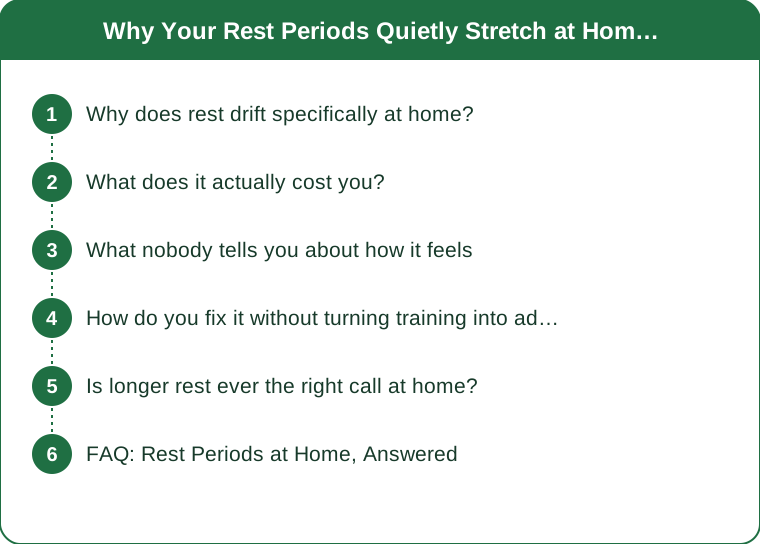
Why does rest drift specifically at home?
Because every mechanism that regulates rest in a gym is absent.
In a gym, your rest is enforced by things you are not choosing: someone is waiting for the bench, the class moves on, the person next to you finishes and starts again, the clock on the wall is in your eyeline. None of these are willpower. They are environmental.
At home, none of them exist. There is no queue, no class, no ambient pace, and usually no visible clock. The only thing setting your rest is your own sense of when you feel ready — and feeling ready is a moving target that gets more generous as the session goes on.
Three things reliably extend it:
- The phone. Checking one thing between sets is 40 seconds minimum, and it is rarely one thing.
- Household interruption. A word with someone, moving something out of the way, the dog. Each costs a minute and none feel like rest.
- Set-up time counted as work. Changing a band, adjusting a mat, moving a weight — this happens inside your rest period but does not feel like rest, so you add rest afterward.
The drift is gradual, which is why it is invisible. Nobody goes from 60 seconds to three minutes overnight. They add ten seconds a week for two months.
What does it actually cost you?
A great deal more than the extra minutes suggest.
Rest period length is not a minor variable. It changes the training adaptation directly.
For strength work with heavy loads, longer rest is often correct — two to three minutes lets you produce more force on the next set. Drift here costs you less, and may cost you nothing.
For hypertrophy and general fitness work, which is what most home training is, rest of 60 to 90 seconds is the working range. Drifting to two and a half minutes means:
- Lower metabolic stress, one of the drivers of muscle adaptation.
- Much lower cardiovascular demand, so the conditioning benefit largely disappears.
- Lower total work density — the same work spread over more time.
For circuit or conditioning formats, drift destroys the entire point. A circuit with two-minute gaps is not a circuit.
The maths is stark. Twelve working sets with 60-second rest is roughly 12 minutes of rest. The same twelve sets at 2:15 is 27 minutes. If your session is still forty minutes long, you have gone from 28 minutes of work to 13 — while doing the identical program and feeling like you trained.
What nobody tells you about how it feels
A drifted session feels harder, not easier. That is the trap.
You would expect more rest to make a workout feel easy, and to notice immediately. It does the opposite for two reasons.
First, each individual set feels harder. Fully rested, you can push a set closer to failure, so the sets you do perform are more intense in the moment. The session produces a strong sensation of effort.
Second, the session feels long — because it is. Forty minutes of mostly waiting feels like a long forty minutes, and length gets interpreted as difficulty.
So the subjective experience is: hard sets, long session, definitely trained. Every internal signal says the workout was fine.
Meanwhile the objective picture is a session with less than half its previous work density, which is why the results stalled.
This is the specific reason home workout plateaus are so confusing. With a gym plateau you usually notice something — the weights are not moving, the sessions feel shorter. With a home rest drift plateau, everything feels the same or harder while the actual stimulus quietly halves.

How do you fix it without turning training into admin?
Five things, in order of how much they do relative to the effort.
1. Use a visible countdown timer, not a stopwatch. This is nearly the whole fix. A stopwatch requires you to check and decide. A countdown that beeps removes the decision entirely. Start it the instant the last rep finishes, not once you have put the weight down and had a think.
2. Put the phone across the room. If the timer is on your phone, set it and walk away, or use a cheap kitchen timer or a watch. The phone in your hand between sets is the largest single source of drift.
3. Count your set-up inside the rest. Changing bands, moving weights and adjusting position happen during the rest period, not before it starts. This alone recovers a surprising amount.
4. Write the rest period in the plan. Not 3 sets of 10 but 3 x 10, 75s. If it is not written, it is not a target and it will drift.
5. Audit one session a month. Time the whole workout and count the working sets. Total minutes divided by sets tells you your real density, and comparing it to two months ago is usually all the evidence anyone needs.
A seasonal note: as evenings get darker and cooler, home sessions tend to start later and drift more — a cold room genuinely increases the temptation to sit between sets. If your training moved to the evening for autumn, audit it now rather than in November.
Is longer rest ever the right call at home?
Yes, in three specific situations, and it is worth knowing them so you do not over-correct.
1. Genuinely heavy strength work. If you are working in the 3-6 rep range near your limit, two to three minutes is appropriate and cutting it will reduce the load you can handle. Drift is only a problem relative to the target.
2. When technique is degrading. If your form on set three is visibly worse than set one and more rest fixes it, take the rest. A well-executed set after 2 minutes beats a sloppy one after 60 seconds.
3. Returning after a break. Coming back after weeks off, longer rest is sensible for the first two or three sessions while your work capacity rebuilds. Set it deliberately, and put it back afterward.
What all three have in common is that the rest is chosen. The problem is never long rest — it is unchosen rest that grew without a decision.
The test: can you say what your rest period is supposed to be for the exercise you are doing right now? If yes, you are fine at any length. If no, it has already drifted.
This is general information, not medical advice — if you have a condition affecting exercise tolerance, follow guidance specific to you rather than generic rest targets.
FAQ: Rest Periods at Home, Answered
What rest should I use if I have no idea?
Ninety seconds is a reasonable default for general strength and hypertrophy work at home. Drop to 60 for smaller muscle groups and accessory work; extend to two or three minutes only for genuinely heavy compound sets.
Does the drift matter if I am training for general health rather than gains?
Less, but it still matters for the cardiovascular component. A drifted session provides considerably less conditioning benefit, which for general health is often the part people most want.
Should I use a timer for warm-ups too?
No need — warm-ups are self-limiting and rarely drift. It is the working sets, particularly the last third of the session, where the extra minutes accumulate.
TL;DR:
- Home training has no environmental enforcement of rest, so it drifts by ten seconds a week until sets are two-plus minutes apart.
- Drift can cut work density by 30-40% while the session length stays identical.
- It feels harder, not easier, which is why it goes undetected and gets mistaken for a plateau.
- Fix with a visible countdown timer started the instant a set ends, the phone across the room, and set-up counted inside the rest.
- Long rest is fine when it is chosen — for heavy strength work, degrading technique, or returning after a break.
Before you change your program because it stopped working, time one session and divide by the number of sets. A large share of home training plateaus are not program problems at all — they are twenty-five minutes of rest wearing a forty-minute workout’s clothes.
Keep Reading
This article is for general informational purposes only and is not medical advice. It is not a substitute for professional diagnosis or treatment. Always consult a qualified healthcare provider about your individual situation, especially before making significant changes to your diet or exercise routine.