Why Your Downstairs Neighbour Decides Which Home Workout You Can Do
Quick Answer: Impact noise travels through building structure rather than air, which is why a jump lands in your neighbour’s ceiling no matter how thick your mat is. Mats reduce it; they do not solve it. The practical answer is to replace impact-based intensity with tempo, unilateral work, isometric holds, and load - all of which are quieter and, for most general fitness goals, at least as effective. You lose plyometrics and very little else.
The constraint is real. The programme you build around it is usually better than the one you were copying.
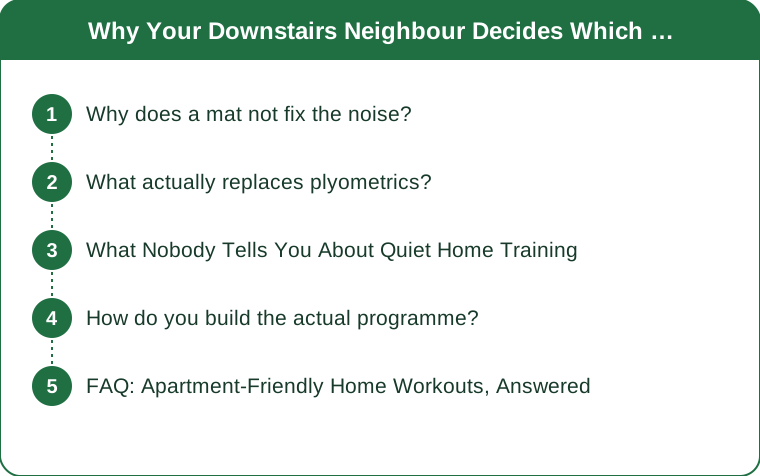
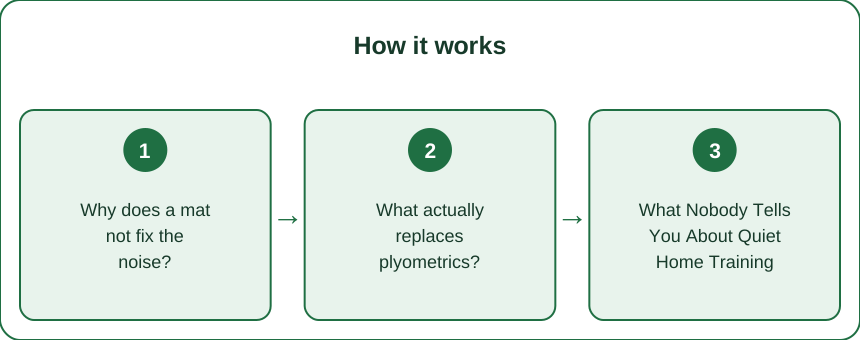
Why does a mat not fix the noise?
There are two kinds of noise and they behave completely differently. Airborne noise - music, voices - is reduced by soft surfaces. Impact noise travels through the structure itself.
A jump landing sends a shock into the floor slab, which radiates through the building frame and emerges as a thud in the room below.
Mats absorb some of that energy and genuinely help, but a thin yoga mat does very little for the frequencies that carry.
Thicker rubber or interlocking foam tiles perform considerably better than a yoga mat, especially in layers.
Timber-framed buildings transmit impact more than concrete ones, so the same routine can be fine in one block and unbearable in another.
And dropped weights are worse than any jump, which is why they are the first thing to eliminate rather than the last.
What actually replaces plyometrics?
Tempo work. Taking three to five seconds on the lowering phase of a squat or push-up produces substantial training stimulus with no impact at all.
Unilateral work. Split squats, single-leg deadlifts, and step-ups load one leg at a time, so bodyweight becomes meaningfully heavy.
Isometric holds. Wall sits, split squat holds, and planks are silent and genuinely demanding.
Range of motion. Deficit variations and full-range work raise difficulty without adding speed.
External load. A couple of adjustable dumbbells or a kettlebell replaces the intensity that jumping was providing, quietly.
And bands, which add resistance with essentially zero noise and are the single best value purchase for an apartment.
What Nobody Tells You About Quiet Home Training
Slow eccentric work is harder than jumping for most people, and produces more soreness - it just does not feel intense in the moment because your heart rate stays lower.
Conditioning is the genuinely hard part to replace, not strength. Strength has silent options; getting properly out of breath without impact takes more creativity.
The best quiet conditioning tools are cycling, rowing on a quality machine, loaded carries in a hallway, and high-rep unilateral work - not jumping jacks done softly.
Landing quietly is a skill worth having regardless. If you must jump, landing softly through the whole foot with a bent knee reduces both noise and joint load.
Shoes make an audible difference, and training barefoot or in socks on a mat is quieter than in cushioned trainers, which slap.
Time of day matters more than technique in most buildings, and a conversation with the neighbour beats a guess about what they can hear.
And the mat under the mat is the trick most people miss - a dense rubber layer under a foam layer outperforms either alone.
How do you build the actual programme?
Two or three strength sessions a week built on tempo squats, split squats, hinges, push-ups, and rows.
Progress by tempo, then range, then load rather than by adding speed.
Use isometric finishers - a long wall sit or split squat hold - instead of a jumping circuit.
Put conditioning on a bike, a rower, or a walk outside rather than trying to force it into the living room.
Add carries if you have a hallway - they are quiet, demanding, and carry over well to daily life.
And keep the total session under 40 minutes, since home sessions fail on consistency far more often than on programming.
FAQ: Apartment-Friendly Home Workouts, Answered
Will a thicker mat let me do jump training?
It helps but does not solve it. Impact noise travels through the structure, not the air. Layered dense rubber under foam is the best version.
What is the quietest way to get out of breath?
High-rep unilateral work, loaded carries, a bike or a rower. Softly done jumping jacks are still impact.
Is slow tempo training actually effective?
Yes - longer time under tension and slow eccentrics are well-established stimuli and are completely silent.
What single purchase helps most?
Resistance bands for value, or a pair of adjustable dumbbells if budget allows. Both replace the intensity jumping provided.
Are barbells possible in a flat?
Only with the discipline never to drop the bar, which is difficult. Dumbbells and kettlebells are far more neighbour-friendly.
Should I just ask my neighbour?
Usually yes. It is faster than guessing and often reveals the problem is a specific time rather than a specific exercise.
TL;DR:
- Impact noise travels through the building structure, so mats reduce it but never solve it.
- Replace plyometrics with tempo, unilateral work, isometric holds, longer range, and external load.
- Slow eccentrics are harder than jumping and completely silent, though they feel less intense at the time.
- Conditioning is the genuine gap - move it to a bike, a rower, carries, or outdoors.
- Layered dense rubber under foam beats a yoga mat, and no dropped weights ever.
The quiet programme is usually the better programme. Build it deliberately rather than apologetically.
Keep Reading
This article is for general informational purposes only and is not medical advice. It is not a substitute for professional diagnosis or treatment. Always consult a qualified healthcare provider about your individual situation, especially before making significant changes to your diet or exercise routine.