Why Your Home Gym Corner Stops Working When the Evenings Get Dark
Quick Answer: Most home training corners were set up in daylight and rely on it. When evenings go dark, the space is under-lit and cold, both of which reduce adherence measurably. Adding a bright, well-positioned light and pre-warming the space are higher-return interventions than any programming change.
The pattern is almost universal and almost never diagnosed correctly. Home training that ran smoothly from May to September starts slipping in October, and everyone involved blames willpower. It’s mostly the room.
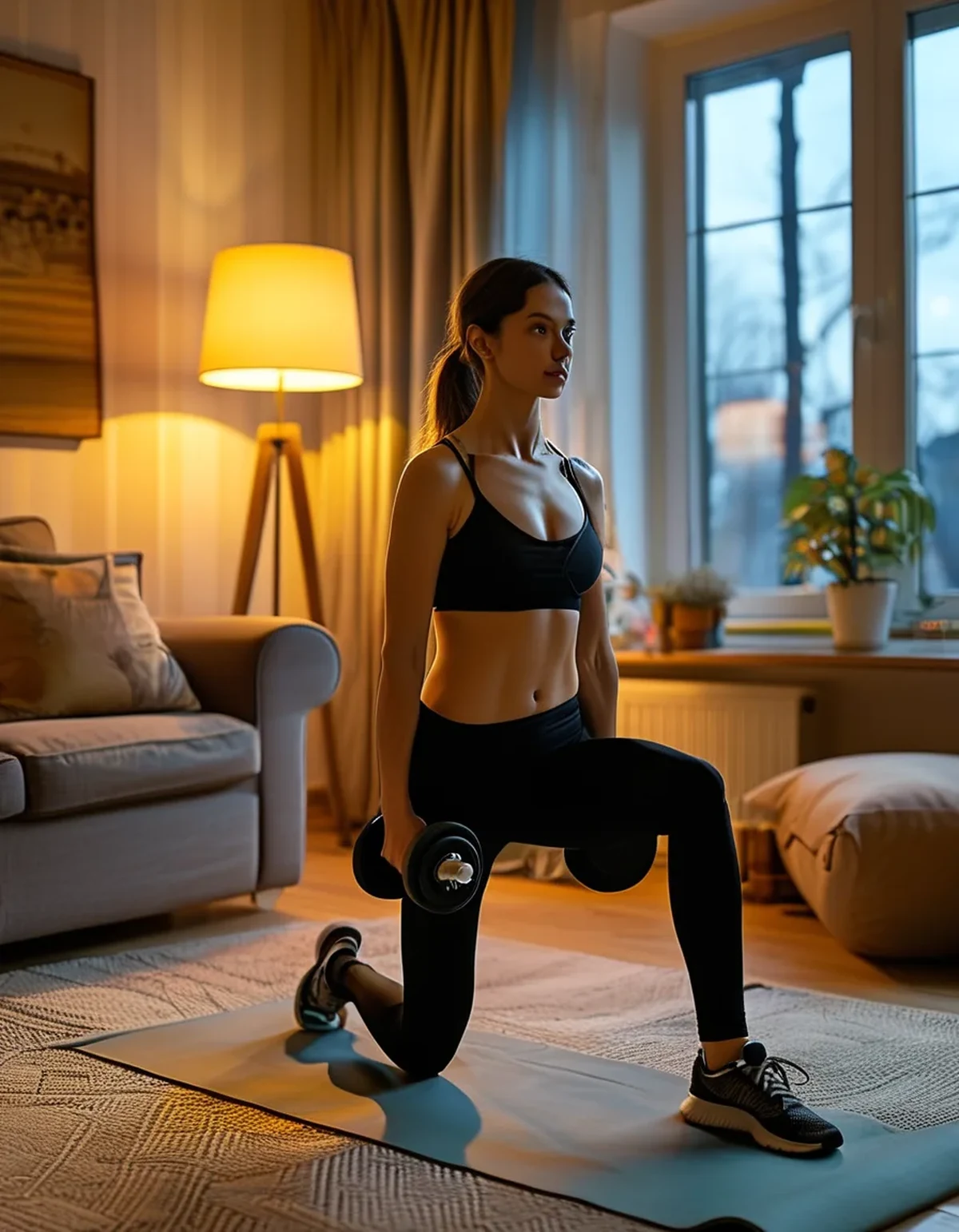
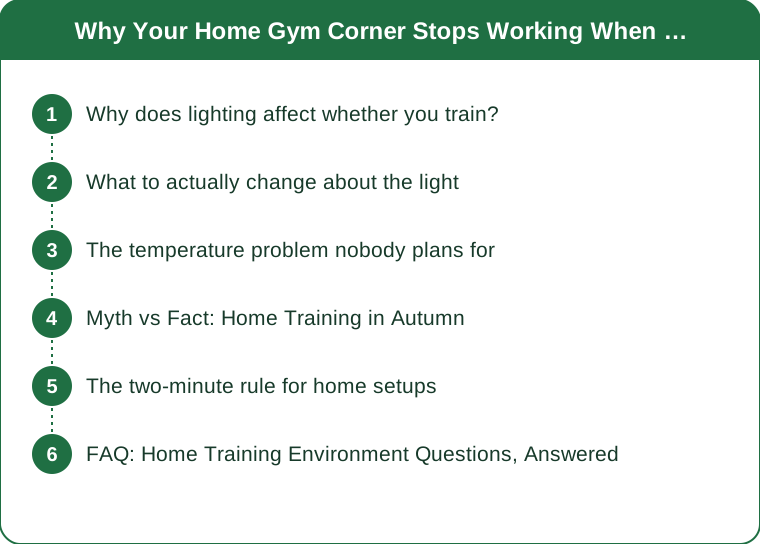
Why does lighting affect whether you train?
Because light level drives alertness through a direct physiological pathway, and because a dim room reads as a non-activity space.
The physiological part is well established. Bright light suppresses melatonin and raises subjective alertness, and the effect is measurable within about fifteen minutes. Training in a dim room at 6pm in October means asking a body that’s already receiving evening signals to produce a morning-level effort.
The psychological part is arguably bigger. Rooms carry behavioural associations, and a dim room is associated with winding down. Turning on a bright light changes what the room means, which is why the same corner feels workable at 400 lux and impossible at 80.
There’s also a practical safety dimension. Poor lighting genuinely increases the risk of catching a dumbbell edge on the doorframe or misplacing a foot on the mat, which is not a theoretical concern in a space designed around a sofa.
What to actually change about the light
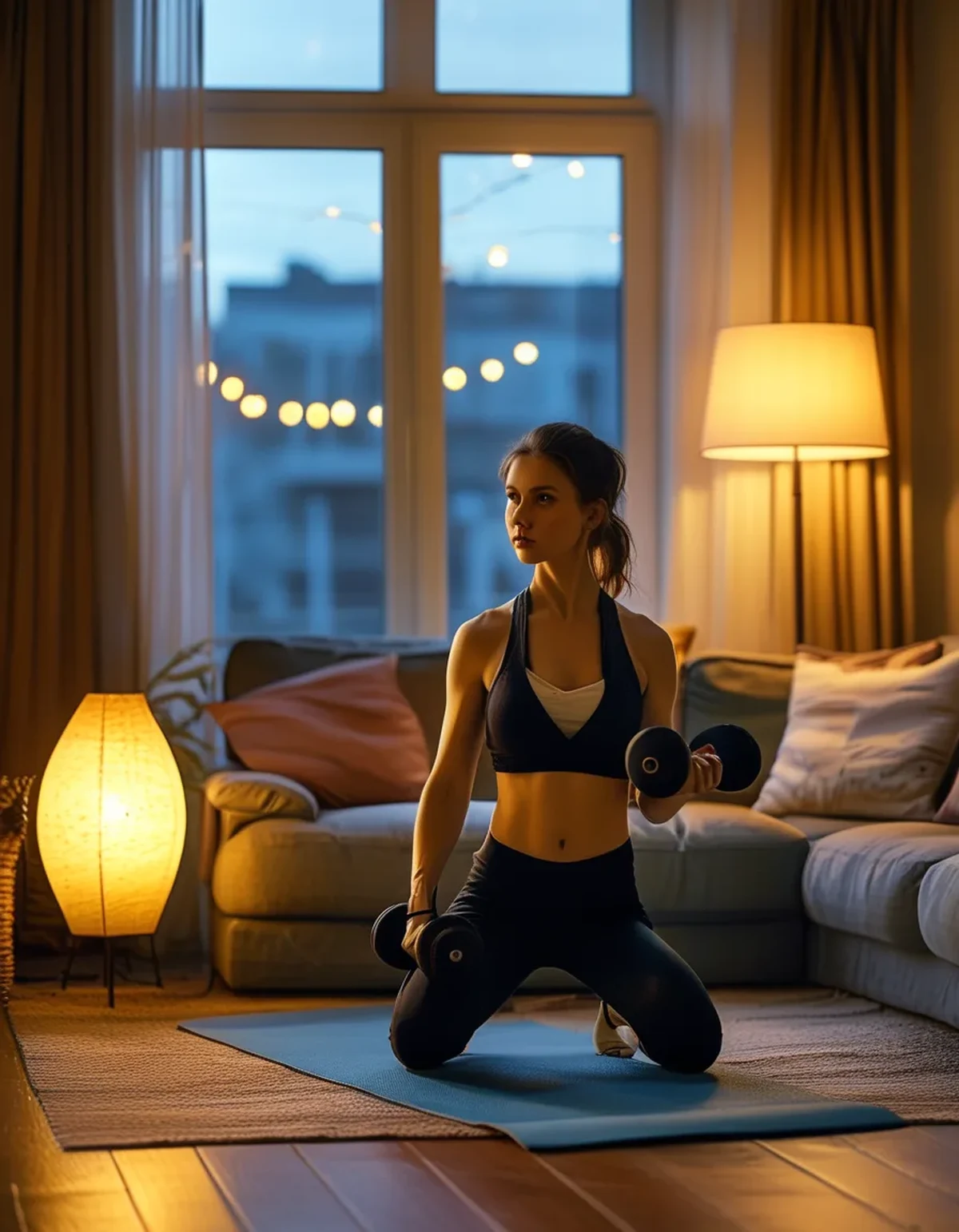
Add a second light source at a different height. A single overhead bulb creates flat, shadowed light that makes it hard to see your own form and reads as ordinary room lighting. A floor lamp or clip light at roughly chest height changes the character of the space substantially.
Aim for bright and cool, not warm. A cooler colour temperature, around 4000 to 5000 kelvin, is more alerting than the warm 2700 kelvin most homes use in the evening. A single swappable bulb is enough.
Position it so you can see yourself. Whether that’s a mirror or a phone propped for form checks, being able to see what you’re doing matters for both quality and engagement.
Turn it on ten minutes before you train. Light exposure needs a little time to shift alertness, and walking into an already-bright room is a meaningfully different experience from flicking a switch and starting.
This is the cheapest intervention available to a home trainer in autumn, and it consistently outperforms new equipment.
The temperature problem nobody plans for
A cold room raises the barrier to starting more than it raises the difficulty of training.
The specific issue is the first five minutes. Changing into training clothes in a cold room, then doing a warm-up in a cold room, is genuinely unpleasant, and unpleasant starts are where home routines die. Once you’re twenty minutes in and producing heat, the cold room is actually preferable.
So the intervention is targeted at the start, not the whole session. Heat the space for fifteen minutes beforehand, or train in more layers than you need and remove them as you warm up. Both work; the second is free.
There’s also a mobility dimension. Cold tissue is stiffer, and a home session that starts with floor work on a cold floor asks a lot of a cold body. Extending the warm-up by five minutes in winter is a reasonable default, and doing the first few minutes standing rather than on the floor helps.
A cold floor specifically is worth solving. A thicker mat, or training on a rug, changes the experience of any floor-based work considerably.
Myth vs Fact: Home Training in Autumn
Myth: If you were motivated in summer, motivation is the problem in autumn. Fact: Adherence research consistently finds environmental friction predicts behaviour better than stated motivation. The environment changed; the motivation didn’t have to.
Myth: Morning training solves the dark-evening problem. Fact: It moves the problem, since autumn mornings are also dark and are additionally cold. It works well for some people, and it works because it’s earlier in the day rather than because it’s brighter.
Myth: You need to buy more equipment to keep home training interesting. Fact: Equipment purchases correlate poorly with continued training. Novelty fades in about two weeks. Fixing light, temperature, and the setup time is what changes the curve.
Myth: A dedicated room is required for consistency. Fact: Helpful but not necessary. What matters is that setup takes under two minutes. A corner with the mat already down beats a spare room where the equipment lives in a cupboard.
The two-minute rule for home setups
The strongest predictor of whether a home session happens is how long it takes to start.
If setup takes more than about two minutes, moving furniture, finding weights, clearing a space, the session becomes a decision rather than a default, and decisions lose to tiredness reliably.
Leave the mat down if you possibly can. This one change has an outsized effect and it’s the one most people resist for tidiness reasons.
Keep the weights visible and reachable, not in a cupboard. Visible equipment functions as a cue; hidden equipment functions as a task.
Have the session written down before the day starts. Deciding what to do while standing in the room is a surprisingly effective way to end up not training.
Keep a set of training clothes accessible, not in the wash pile. Trivial, and it’s a documented failure point.
Pick a fixed time and defend it. Home training has no external schedule, and in a season where evenings get busier, an undefended slot disappears.
Add up those five and setup goes from ten minutes to under two, which is the difference between a routine and an intention.
FAQ: Home Training Environment Questions, Answered
How bright does the space actually need to be?
Aiming for something in the range of a well-lit kitchen rather than a lounge is the practical target. If you’d read a book comfortably there, it’s probably enough.
Is training in a cold room dangerous?
Not inherently, but it does mean a longer warm-up and more caution with loaded or explosive movements early on. Layer up and extend the warm-up rather than skipping it.
What if I genuinely can’t leave equipment out?
Reduce what needs setting up. A single kettlebell or a set of bands in a basket by the sofa is a two-minute setup; a rack and a bench in a cupboard is not.
TL;DR:
- Home training slips in autumn because the room went dark and cold, not because motivation collapsed.
- Add a bright, cooler-temperature second light at chest height and turn it on ten minutes early.
- Pre-warm the space or layer up for the first five minutes, which is where sessions actually die.
- Get setup time under two minutes: mat down, weights visible, session written, clothes accessible, time defended.
Fix the room and the routine mostly fixes itself. It’s a considerably cheaper intervention than a new programme.
Keep Reading
This article is for general informational purposes only and is not medical advice. It is not a substitute for professional diagnosis or treatment. Always consult a qualified healthcare provider about your individual situation, especially before making significant changes to your diet or exercise routine.