Why Your Home Workout Space Stops Working When the Clocks Are About to Change
Quick Answer: Most home routines are anchored to daylight without anyone noticing - you train when the room is bright, which in summer is any time and in autumn is a narrow window. When that window closes, the trigger disappears and the habit looks like a motivation failure. The fix is to re-anchor the routine to something that does not change seasonally: a fixed clock time, a light source you control, and equipment that is visible rather than stored. Do this in early September, before the routine breaks, not after.
You trained four times a week from May to August without ever thinking about it.
It is late September, you have managed twice in two weeks, and you have started describing yourself as someone who has lost discipline.

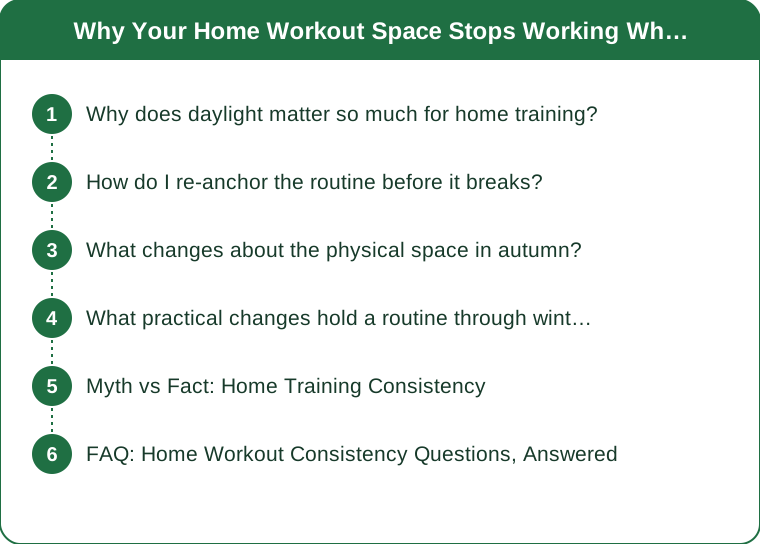
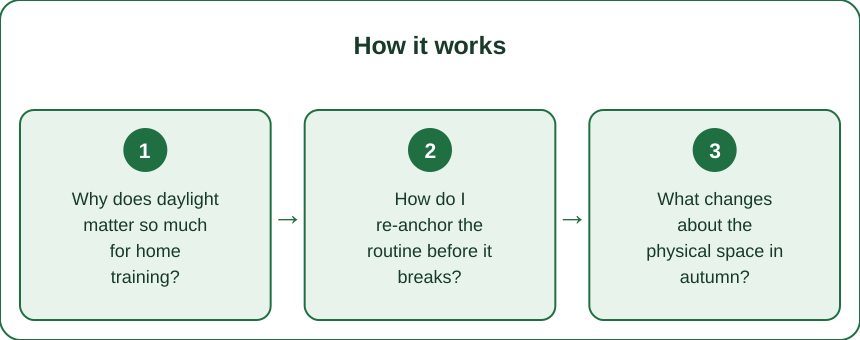
Why does daylight matter so much for home training?
Because a home routine has no external commitment holding it in place. A class has a time and a booking; a home session has only whatever cue you built it on.
For most people that cue is unconsciously visual - the room feels like a place to train when it is bright, and feels like a place to sit down when it is dim.
Summer hides this completely, because the room is bright from six in the morning until nine at night and every time slot works.
As daylight narrows, the number of viable-feeling slots collapses, often to a window that conflicts with work or dinner.
And the collapse is gradual, which is why it registers as a slow motivation decline rather than as an environmental change with a date on it.
Evening light matters more than morning light for most people, because that is when home sessions actually happen.
How do I re-anchor the routine before it breaks?
Pick a clock time and keep it regardless of light. A time-anchored habit survives a season change; a light-anchored one does not.
Fix the lighting deliberately. A single bright lamp aimed at the training area changes the felt character of a room more than any amount of resolve.
Do it in early September while the routine is still intact, because re-anchoring a habit that is still running is far easier than restarting a broken one.
Keep the session length constant rather than shortening it as motivation dips, since a variable-length session is a negotiable session.
Attach it to a fixed daily event - after the school run, before dinner, straight after logging off - rather than to a feeling.
And write the times down for the week ahead, which converts an intention into something closer to an appointment.
What changes about the physical space in autumn?
The room is colder, which matters more than people expect - a cold room needs a longer warm-up and makes floor work genuinely unpleasant.
Windows are closed, so the space feels stuffier during effort and better ventilation becomes something to plan rather than assume.
Furniture tends to migrate back inward as outdoor space stops being used, and the clear floor area you trained in during summer quietly disappears.
Equipment gets stored because the room is being used for more sitting, and out-of-sight equipment is a reliable predictor of an abandoned routine.
Floor surfaces are colder and harder to tolerate, which is a genuine reason people stop doing core and mobility work in autumn.
And the shared-space negotiation changes - the room is occupied by other people more of the time once evenings move indoors.

What practical changes hold a routine through winter?
Keep equipment visible. A kettlebell in the corner of the living room is an unattractive but extremely effective habit device. Stored equipment is unused equipment.
Add a mat you leave out, which removes the largest single point of friction for floor work and solves the cold floor problem at once.
Warm the room before you start rather than warming up harder, which is a real and often overlooked adjustment.
Plan a specific fallback session - fifteen minutes, no equipment, no thought - for the days the full one will not happen. A defined fallback is what keeps a streak alive.
Change the training itself if it needs changing. Summer routines are often outdoor-adjacent and lighter; autumn is a good time to move toward strength work, which suits an indoor space better.
And schedule the sessions like appointments in whatever calendar you actually use, which sounds trivial and outperforms almost every motivational intervention.
Myth vs Fact: Home Training Consistency
Myth: autumn drop-off is a motivation problem.
Fact: it is usually an environmental cue problem. The behaviour was anchored to something seasonal, and the anchor moved. Fixing the anchor works; trying to want it more generally does not.
Myth: you need a dedicated room to train at home consistently.
Fact: you need a consistent time and visible equipment. Plenty of people train reliably in a living room, and plenty of people ignore a fully equipped spare room for months.
Myth: shorter sessions are a compromise.
Fact: a reliable twenty-minute session beats an aspirational hour that happens twice a month. Consistency is the variable that drives results at this level of training.
Myth: you should push through when the routine slips.
Fact: pushing harder on the same broken setup rarely works. Change one structural thing - the time, the light, the location of the equipment - and the behaviour usually returns without additional willpower.
Myth: it is too late to fix it once you have missed two weeks.
Fact: two weeks off produces very little measurable detraining. The barrier at that point is entirely psychological, and the fastest route back is a deliberately easy session rather than a punishing one. This is general information, not medical advice.
FAQ: Home Workout Consistency Questions, Answered
When should I make the autumn adjustment?
Early September, while the routine is still working. Re-anchoring a live habit is much easier than restarting a dead one, and the change takes about ten minutes.
Morning or evening for home training in winter?
Whichever is more protected from interruption. For most people that is morning in winter, because evenings become more crowded and lower energy once it is dark by five.
How do I keep training in a cold room?
Warm the room before you start, keep a layer on for the warm-up, and put a mat down permanently. Cold floors stop more core routines than cold air does.
How much fitness do I lose over a two-week gap?
Very little measurably. Strength and cardiovascular fitness both hold up well across a short gap, and the main cost is the habit rather than the adaptation.
Should I change my programme for autumn?
It is a natural point to shift toward strength work, which suits indoor space and shorter days better than the outdoor-adjacent training many people do in summer.
What is the single highest-return change?
Leaving the equipment and mat out where you can see them. It is the cheapest and most consistently effective intervention in home training.
How do I handle sharing the space with family in the evenings?
Pick a fixed slot and tell them about it, rather than looking for a gap each day. An announced time is respected far more reliably than an implied one.
TL;DR:
- Home routines are usually anchored to daylight without anyone noticing, and autumn removes the anchor.
- Re-anchor to a fixed clock time and a light source you control, in early September rather than October.
- Keep equipment and a mat visible and out - stored equipment is unused equipment.
- Warm the room rather than warming up harder, and expect floor work to be the first casualty of a cold room.
- Define a fifteen-minute fallback session for the days the real one will not happen.
It is not discipline that failed, it is the cue. This is general information, not medical advice.
Keep Reading
This article is for general informational purposes only and is not medical advice. It is not a substitute for professional diagnosis or treatment. Always consult a qualified healthcare provider about your individual situation, especially before making significant changes to your diet or exercise routine.