Why Your Home Workout Quietly Gets Shorter Every Week
Quick Answer: Without an external endpoint, every session ends when you decide it does, and that decision is made while tired. Each week the endpoint moves slightly earlier and becomes the new normal, so the decline is invisible from inside. A gym class ends when it ends; a home session ends when you stop. Fix it by making the session count-based rather than time-based, writing it down before you start, and recording what you actually did.
Nobody notices losing two minutes a week. Everybody notices being down eighteen minutes six months later.
This blog has covered why a 20-minute home workout always takes 40, why home workouts stop working after two months, and why they get harder to start once it is dark at five. Session creep is the mechanism underneath all three.

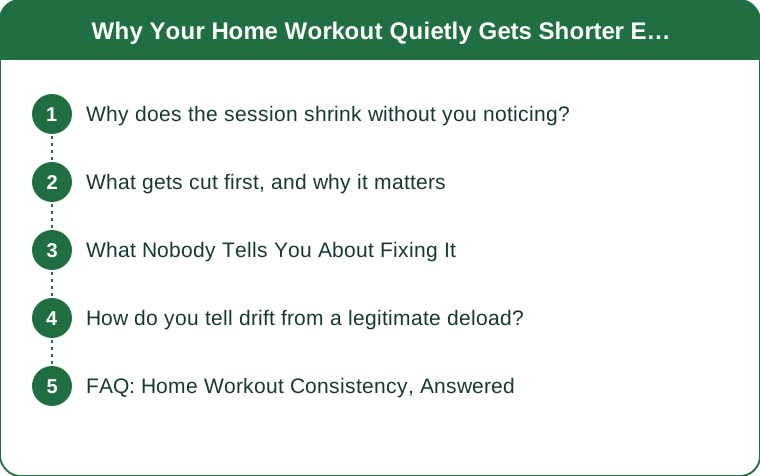
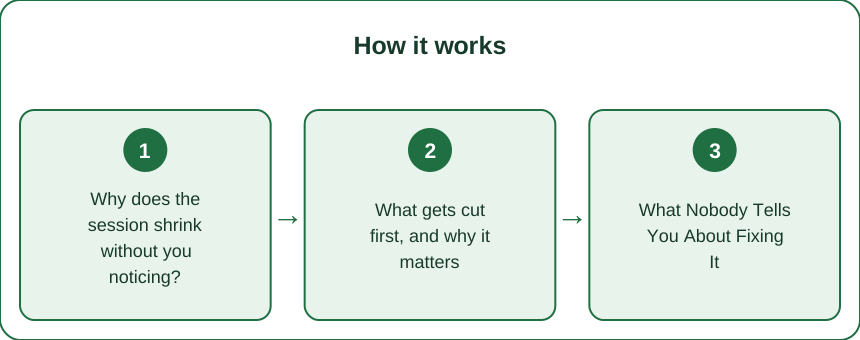
Why does the session shrink without you noticing?
Because each individual decision is reasonable and only the trend is a problem.
Every ending is a judgement call made at the point of maximum fatigue and minimum motivation, which is the worst possible moment to be deciding anything.
Each cut is small enough to be justifiable. Skipping the last set, dropping the cool-down, cutting the third round — none of them feel like a decline.
The new length becomes the reference point immediately. Next week you are comparing against last week, not against January, so the drift is invisible.
There is no external endpoint. A class ends because the class ends; a home session ends because you stopped, and that is an entirely different mechanism.
There is no witness. Nobody notices, nobody comments, and there is no social cost to a short session.
And the workout that gets cut is the one at the end, which is usually the accessory or conditioning work — the part that was providing much of the actual adaptation.
What gets cut first, and why it matters
Predictably, in this order, and each one costs you something specific.
The cool-down goes first, usually within the first fortnight. Low cost individually, but it is the thin end.
The warm-up gets shortened next, which raises injury risk and reduces the quality of the first working set — the exact set that determines the session.
The last set of the last exercise goes third. This is where a lot of the volume-driven adaptation lives, and it is the set most likely to be near failure.
Rest periods get shorter, which sounds like intensifying but usually just reduces the load you can handle in the following set.
Then the exercise count drops. Six movements becomes four, usually losing the ones you like least — which are frequently the ones addressing your weakest areas.
And finally the session frequency goes. Four days becomes three becomes two, at which point people conclude that home workouts do not work for them.
Note that the parts you enjoy are never the parts that get cut, which is why the remaining session is progressively less balanced as well as shorter.

What Nobody Tells You About Fixing It
The fix is structural and takes about two minutes a week.
Make the session count-based, not time-based. “Three rounds of five movements” has a defined endpoint; “about half an hour” does not, and only one of those survives a tired Thursday.
Write the session down before you start, on paper or in a note. A written plan is an external endpoint, which is the thing home training is missing.
Record what you actually did. Not for the data — for the fact that a written record makes drift visible, and invisible drift is the entire problem.
Put the part you dislike in the middle. Anything at the end will eventually be cut, so nothing important should live there.
Set a minimum session rather than a target. “At least two rounds, whatever happens” is far more robust than a target you either hit or fail, and it prevents the all-or-nothing skip.
Use a timer for rest periods. Untimed rest expands invisibly and is a large part of why a 20-minute workout takes 40.
Review your log monthly. Two minutes comparing this month to last is enough to catch a decline while it is still a small correction.
And put the cool-down first if it keeps getting cut. Mobility work at the start is better than mobility work that never happens.
How do you tell drift from a legitimate deload?
By whether you decided it in advance.
A planned reduction is a deload. An unplanned one is drift. The distinguishing feature is entirely whether it was chosen before the session, not how it felt during.
Deloads are legitimate and necessary — typically a lighter week every four to eight weeks of hard training — but they are scheduled and they end on a defined date.
Drift has no end date, which is why it never reverses on its own.
A useful test: could you say what your session length was six weeks ago? If not, you have no way of detecting drift and it is almost certainly happening.
Genuine life changes justify a permanent reduction too — but then set the new plan explicitly at 25 minutes and defend that, rather than letting 40 erode toward 15.
And a short session done consistently beats a long one abandoned. The failure mode here is not short workouts; it is unacknowledged decline that ends in stopping altogether.
FAQ: Home Workout Consistency, Answered
Why do my home workouts keep getting shorter?
Because without an external endpoint, every session ends on a decision made while tired, and each week’s slightly earlier ending becomes the new reference point. The decline is invisible from inside because you are always comparing to last week rather than to where you started.
How do I stop cutting my workouts short?
Make the session count-based rather than time-based, write it down before you start, and log what you actually completed. A written plan supplies the external endpoint that a gym class provides automatically.
Is a shorter workout still worth doing?
Yes — consistency matters more than length, and a minimum session you always complete beats a long one you skip. The problem is not short workouts; it is unmonitored decline, which tends to end in stopping altogether.
TL;DR:
- Home sessions end on a decision made at peak fatigue, and each new shorter length instantly becomes the reference point.
- The cut order is predictable: cool-down, warm-up, last set, rest periods, exercise count, then frequency.
- Make sessions count-based, write them down before you start, and log what you did. Visibility is the whole fix.
- Never put something important at the end of the session — anything at the end eventually gets cut.
If you cannot say what your session length was six weeks ago, it has almost certainly been shrinking.
Keep Reading
This article is for general informational purposes only and is not medical advice. It is not a substitute for professional diagnosis or treatment. Always consult a qualified healthcare provider about your individual situation, especially before making significant changes to your diet or exercise routine.