Why Your Home Workout Mirror Check Is Quietly Lying to You About Your Form
Quick Answer: A flat mirror check only shows a front-on, mirrored view at one fixed angle, which hides depth-based form issues like knee tracking, spinal rounding, or weight shift that a side-angle video would reveal — meaning “looking fine” in the mirror doesn’t rule out meaningful form problems.
It looks perfectly aligned in the mirror the whole set. On video from the side, a completely different story shows up.

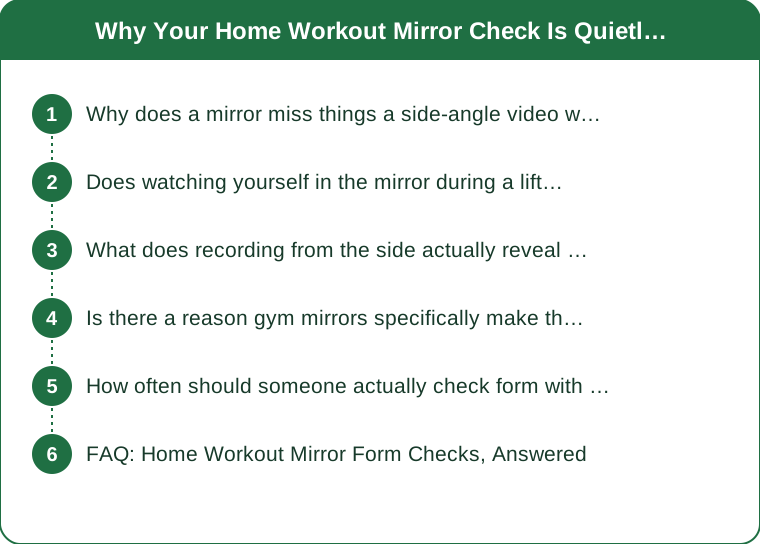
Why does a mirror miss things a side-angle video would catch?
A mirror only reflects a single flat plane, generally straight-on, which means depth-based movement — how far the hips shift back, how much the spine rounds, whether the torso leans excessively forward — is largely invisible from that angle. Front-facing mirror checks are genuinely useful for side-to-side symmetry issues like uneven knee position, but they simply can’t show what’s happening in the front-to-back plane where many common form faults actually occur.
Does watching yourself in the mirror during a lift actually change the movement itself?
Yes, somewhat — turning the head to check the mirror mid-rep can subtly shift spinal alignment and weight distribution compared to looking straight ahead or slightly down as most coaching cues recommend, meaning the very act of checking can introduce a small form change that wouldn’t happen during a normal, unwatched rep.
What does recording from the side actually reveal that a mirror can’t?
Side-angle video shows hip hinge depth, knee-over-toe positioning, spinal curve throughout the full range of motion, and weight shift from heel to forefoot — all details that are essentially invisible in a straight-on mirror reflection, which is why many coaches recommend occasional side-view video specifically over relying on a mirror alone for the deeper mechanical details.

Is there a reason gym mirrors specifically make this worse than expected?
Some gym and home mirror setups are placed at a slight downward or upward angle depending on wall height and mounting, which can subtly distort perceived alignment further, making a person believe their back is flatter or their knees are more aligned than a true perpendicular view would show.
How often should someone actually check form with video instead of just a mirror?
Recording a short side-angle clip every few weeks, or whenever attempting a new weight or rep range, catches drift in form before it becomes a habit, while day-to-day mirror checks remain useful for the symmetry and general awareness checks they’re actually good at.
FAQ: Home Workout Mirror Form Checks, Answered
Is it worth buying a second angled mirror just for side-view checks?
It can help, but a phone propped up for a quick video clip is generally more practical and gives a reviewable, pausable view a second mirror alone can’t provide.
Does this mirror limitation apply to all exercises equally?
No — exercises with more front-to-back movement (squats, deadlifts, hip hinges) are more affected than exercises that happen mostly in the frontal plane, like lateral raises, where a mirror check is more genuinely reliable.
Can a training partner substitute for video review?
Yes, and often better — a partner watching from the side in real time can give immediate cues a delayed video review can’t, making it a strong alternative when available.
TL;DR:
- A mirror only shows one flat, front-on plane, hiding front-to-back form issues
- Checking the mirror mid-rep can itself subtly alter spinal alignment and weight shift
- Side-angle video reveals hip depth, knee tracking, and spinal curve a mirror can’t
- Some mirror mounting angles further distort perceived alignment
- Occasional side-view video review catches form drift a daily mirror check would miss
The mirror isn’t useless — it’s just answering a different question than the one that usually matters most.
Keep Reading
This article is for general informational purposes only and is not medical advice. It is not a substitute for professional diagnosis or treatment. Always consult a qualified healthcare provider about your individual situation, especially before making significant changes to your diet or exercise routine.