Why Your Home Workout Intensity Drops Without You Noticing
Quick Answer: Home training lacks the external structure that drives intensity — no class pace, no heavier plate to reach for, nobody watching. Without deliberate progressive overload, sessions drift toward the same comfortable effort indefinitely. Fix it by writing down reps and load every session, using tempo and range as overload when you cannot add weight, and taking at least one set of each exercise close to genuine failure.
You never missed a session.
And you look and feel exactly the same as in March.
Consistency without progression is maintenance.

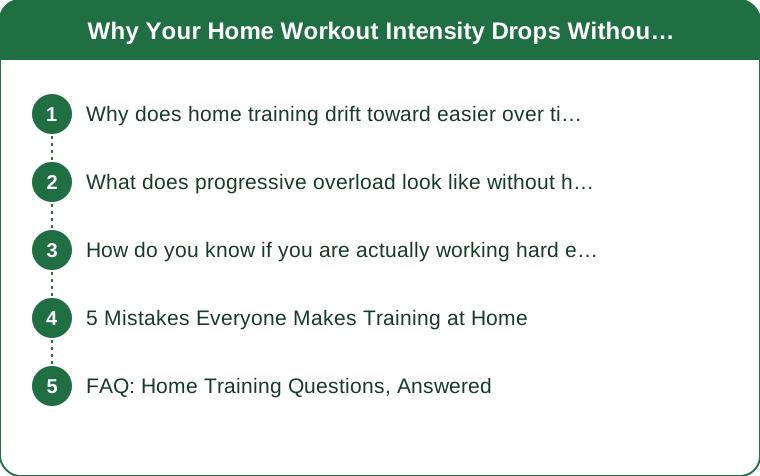
Why does home training drift toward easier over time?
Because nothing in the environment pushes back.
No external pacing. A class sets the tempo and the rest periods. At home, rest quietly expands from 60 seconds to two minutes to whenever you pick the phone up.
No load ceiling to reach for. In a gym, the next dumbbell up is visible on the rack. At home, if your heaviest is 12kg, 12kg becomes both the ceiling and the habit.
No social effort floor. Being around other people training raises effort measurably, whether or not anyone is looking at you.
Familiarity reduces perceived effort. The same routine feels easier over time even at identical load, so you feel like you are working just as hard while doing less.
Nothing is recorded. Without a log, there is no way to notice that this month’s sets look exactly like April’s. Memory is unreliable and biased toward believing you progressed.
And interruptions fragment sessions. Home training gets paused — the door, the kettle, a message. Fragmented sessions have far less cumulative intensity, and the clock does not show it.
What does progressive overload look like without heavier weights?
Six variables, all usable with fixed equipment.
Add reps first. The simplest. If you did 3 sets of 8 last week, do 3 sets of 9 or 10. When you reach the top of a range — say 12 reps — increase difficulty another way and drop back down.
Slow the tempo, especially the lowering phase. A 3 to 4 second eccentric with the same weight is substantially harder and produces a real stimulus. This is the single most effective overload available with fixed dumbbells.
Increase range of motion. Deficit split squats with the front foot elevated, push-ups on handles for a deeper position. More range means more work at the same load.
Reduce rest. Cutting rest from 90 to 60 seconds raises density and makes the same session meaningfully harder.
Change leverage. Move toward single-limb versions — single-leg deadlifts, Bulgarian split squats, single-arm presses. Half the body doing the same work is effectively double the load.
Add pauses. A 2-second pause at the hardest point of a movement removes momentum and increases time under tension considerably.
And add sets last. More volume works, but it is the least time-efficient option and the first thing to make sessions unsustainably long.

How do you know if you are actually working hard enough?
Six markers that beat how a session felt.
Track reps in reserve. At the end of a set, ask how many more you could have done. For a productive strength set, the answer should be 1 to 3. Most home sets end at 5 or more, which is the core of the problem.
Take one set per exercise close to failure. Not every set, and not every session — but if no set in a week is genuinely hard, the stimulus is unlikely to be enough.
Write it down every session. Exercise, weight, reps, and a note on effort. This one habit does more for home training than any equipment purchase, because it makes drift visible.
Compare against the same session six weeks ago. If the numbers are identical, you are maintaining, which may be fine — but it should be a decision rather than a surprise.
Use a timer for rest. Untimed rest expands invisibly. A timer keeps density honest.
Test something occasionally. Max push-ups, a timed carry, a heaviest set. A benchmark every 6 to 8 weeks gives you an objective answer that feel cannot.
This is general information, not medical advice.
5 Mistakes Everyone Makes Training at Home
Mistake one: not writing anything down. Without a log there is no progressive overload, because there is no reference point. This is the difference between training and exercising, and it costs nothing to fix.
Mistake two: assuming consistency equals progress. Showing up is necessary and not sufficient. Six months of identical sessions produces six months of maintenance.
Mistake three: too many exercises, too little intensity. Home sessions tend to sprawl across twelve movements at moderate effort. Four to six exercises taken genuinely close to failure beats twelve comfortable ones.
Mistake four: treating light dumbbells as a hard limit. Tempo, range, single-limb variations and pauses can make a 10kg dumbbell genuinely challenging. The equipment is rarely the actual constraint.
Mistake five: untimed rest. This is the invisible one. Rest expands session by session until a 45-minute workout contains 20 minutes of training. A timer fixes it immediately.
And the one that stalls most home programmes: never changing the programme. The same routine for a year is comfortable, familiar and progressively less effective. Change the exercise selection every 8 to 12 weeks, even if the equipment stays the same.
FAQ: Home Training Questions, Answered
How do I progress without heavier weights?
Reps, tempo, range, rest, leverage and pauses — in roughly that order. Slowing the lowering phase to 3 to 4 seconds is the most effective single change.
How hard should a set be?
End with 1 to 3 reps in reserve on your working sets. Most home sets end far short of that.
Do I need to train to failure?
Not every set. One set per exercise taken close to failure is a reasonable target, and it is usually the missing ingredient.
How long should a home session be?
30 to 45 minutes of actual training. Longer usually means rest has expanded rather than that more work is happening.
How often should I change the programme?
Every 8 to 12 weeks for exercise selection. Progressive overload within a programme matters more than variety.
Is bodyweight training enough?
For a long while, yes, if you progress the leverage — single-leg work, elevated positions, pauses, slower tempo. Eventually external load becomes the efficient route.
What is the single most valuable habit?
Writing down what you did. It converts exercising into training, and it makes the drift visible before six months have passed.
TL;DR:
- Home training drifts easier because nothing external forces the load up — no pace, no heavier plate, no one watching.
- Consistency without progression is maintenance. That may be fine, but it should be a choice.
- Overload without heavier weights via reps, tempo, range, rest, leverage and pauses.
- End working sets with 1 to 3 reps in reserve, and take one set per exercise genuinely close to failure.
- Write down every session. It is the single highest-value home training habit.
Start a log this week — exercise, weight, reps, effort. In six weeks it will tell you something no feeling can.
Keep Reading
This article is for general informational purposes only and is not medical advice. It is not a substitute for professional diagnosis or treatment. Always consult a qualified healthcare provider about your individual situation, especially before making significant changes to your diet or exercise routine.