Why Your Home Workout Feels Harder in a Warm Room Than at the Gym
Quick Answer: In a warm still room, your body diverts blood to the skin for cooling, which means less is available to working muscle. Your heart rate rises for the same effort, sweat does not evaporate efficiently without airflow, and core temperature climbs. The result is that identical work feels substantially harder. Airflow matters more than temperature — a fan changes the session more than air conditioning does.
The same twenty-minute circuit that felt fine in the gym on Tuesday is brutal in your living room on Thursday. Your fitness did not change. Your room did.
What is your body actually doing in a warm room?
Competing with itself for blood flow.
Exercise raises your core temperature, and your body dumps that heat by moving blood to the skin. In a cool environment that works efficiently. In a warm one, your body has to send progressively more blood to the surface to shed the same amount of heat.
That blood is not available to your muscles. So your heart compensates by beating faster — this is called cardiac drift, and it is why your heart rate climbs during a steady effort in the heat without you working any harder. A heart rate that would be 140 in a cool gym might be 155 in a warm room at identical output.
Sweat is the other half. Sweating does not cool you; the evaporation of sweat cools you. In still, humid air, sweat sits on your skin and drips. You lose the fluid and get almost none of the cooling benefit, which is the worst combination available.
And humidity is the multiplier. Late-summer indoor humidity in a closed room, especially with someone breathing hard in it, climbs quickly. At high humidity, evaporative cooling becomes dramatically less effective, which is why a 78°F humid room feels far worse than a 78°F dry one.
The cumulative effect: higher heart rate, higher perceived effort, earlier fatigue, and reduced power output. You are not less fit on Thursday. You are cooling less efficiently.
Why is a gym so much easier?
Three things, and only one of them is the thermostat.
Air movement. Commercial gyms have HVAC systems moving substantial volumes of air continuously. Moving air strips the saturated layer off your skin and lets sweat evaporate, which is the entire cooling mechanism. This is the single biggest difference and it is not primarily about temperature.
Volume of space. A gym is a large room with high ceilings and a lot of air. Your living room is a small volume that you are actively heating, and a person exercising hard produces a meaningful amount of heat — enough to noticeably raise the temperature of a small closed room within twenty minutes.
Humidity control. Commercial air conditioning removes moisture as it cools. A home AC unit does too, and a fan does not — which is why a fan makes you feel much better without actually lowering the room’s humidity.
There is a psychological piece as well, and it is not nothing. Gym environments carry cues — other people training, equipment, music, the fact that you traveled there — that reliably raise output. A living room carries the opposite cues. So part of the difference is real physiology and part is that home sessions genuinely get less effort, and it is worth being honest about which is which on a given day.
The good news is that the physiological part is fixable for about thirty dollars.
What actually fixes it?
Airflow, first and by a wide margin. Everything else is secondary.
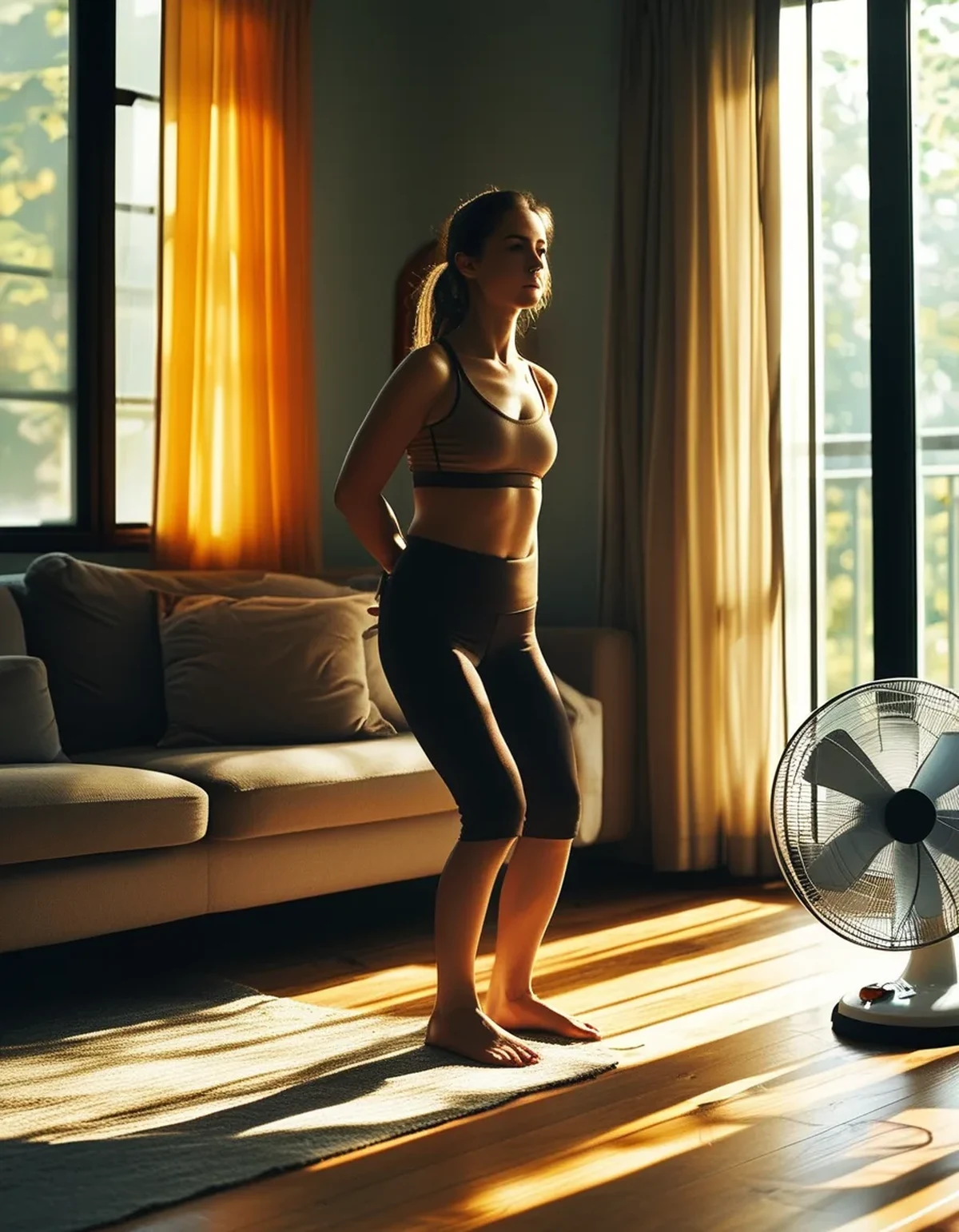
Get a fan pointed at you. Not at the room — at you. A box fan or a pedestal fan aimed directly at your body transforms a home workout, and the effect is immediate and large. This is the highest-return purchase in home fitness and it costs less than a month of most gym memberships.
Cross-ventilate. Two openings on opposite sides of the space moves far more air than one window open. Even in warm outdoor conditions, moving air beats still air.
Train at the right time. Early morning is the coolest part of the day indoors, because the building has shed heat overnight and has not yet absorbed the day’s sun. Late evening in a west-facing room in August is close to the worst option available.
Pre-cool. A cold drink before starting, or a cool shower, lowers your starting core temperature and buys you meaningful time before the heat becomes the limiting factor.
Use a damp towel on your neck between sets. Cooling the skin over major blood vessels is disproportionately effective at reducing perceived effort.
Hydrate before, not just during. You need to start the session hydrated, because you cannot drink fast enough to keep up with a high sweat rate once you are behind.
And close the blinds on sun-facing windows during the day, hours before you train. Solar gain through glass is the main reason a room is 6°F warmer at 6pm than the rest of the house.

5 Mistakes That Make a Warm Home Workout Worse
1. Judging your fitness by how the session felt. A hard-feeling session in a hot room is not evidence of declining fitness, and treating it as such is genuinely demoralizing. Track the work you did — reps, sets, load — not the sensation. The numbers will tell you the truth.
2. Pushing to the same heart rate zones. If you train by heart rate, your zones are effectively wrong in the heat, because cardiac drift inflates the number at any given output. Train by perceived effort or by pace and accept the higher heart rate, rather than backing off the work to hit a number that no longer means what it did.
3. Wearing too much. People wear more at home than at the gym out of habit or self-consciousness, and it directly reduces the skin surface available for cooling. Wear as little as you are comfortable in, in something that wicks.
4. Doing high-intensity work in the worst conditions. Heat penalizes high-intensity intervals far more than steady moderate work, because the recovery between intervals is when you shed heat and warm still air makes that recovery ineffective. Save the hard intervals for the cooler part of the day and do strength or mobility work in the heat.
5. Ignoring the actual warning signs. Feeling hot and tired is normal. Stopping sweating, feeling dizzy or nauseated, getting a headache, or getting chills in a hot room are not — those are signs of heat illness and the correct response is to stop, cool down, and rehydrate. This is general information, not medical advice, and severe symptoms warrant medical attention.
How should you adjust the workout itself?
Change the structure, not just the environment.
Lengthen the rest intervals. If a circuit calls for 30 seconds of rest, take 45 in a hot room. You are recovering from heat as well as from effort, and the recovery takes longer.
Reduce the density before you reduce the load. Keep the weight and the reps, spread them out. You will complete the same total work and the session will take a few minutes longer, which is a much better trade than cutting the work.
Front-load the hard part. Do the demanding work in the first fifteen minutes, before the room and your core temperature have climbed. The last ten minutes of a hot session are disproportionately harder than the first ten, so put the important work where the conditions are best.
Substitute strategically. Floor work and standing work generate different amounts of heat. Anything with your feet leaving the ground — jumping, running, burpees — produces the most heat for the work done. Swapping a jumping circuit for a strength circuit on the hottest days keeps the training going without the same cost.
And plan around the season. This is the last few weeks of it. As mornings cool through September, the early-morning home workout gets easier week by week, and the problem largely solves itself. Knowing that is worth something in mid-August, when it is tempting to conclude that home training does not work for you.
One thing not to do: skip it. A shorter session in a warm room is worth far more than a skipped one, and the consistency matters more over a year than any individual workout’s quality.
FAQ: Warm Room Workout Questions, Answered
Does training in the heat improve my fitness?
Heat acclimatization is a real adaptation — after roughly one to two weeks of regular heat exposure, you sweat earlier and more efficiently and your plasma volume increases, which genuinely improves performance in the heat. It does not make you fitter in cool conditions, and it comes with higher fluid needs and more fatigue while you adapt.
Should I use AC or a fan?
A fan, if you have to choose, and both if you can. A fan moves air across your skin, which is what enables evaporation, and that is the dominant cooling mechanism during exercise. AC lowers both temperature and humidity, which helps considerably, and it is less effective per dollar than a fan pointed directly at you.
Why am I more sore after workouts in the heat?
Partly because heat increases perceived effort and cardiovascular strain, so a session that felt like a nine may have been a seven’s worth of muscular work with a lot of heat stress on top. Dehydration also worsens soreness. The muscle damage itself is not usually greater — the recovery is just slower.
TL;DR:
- In a warm room, blood is diverted to your skin for cooling, so heart rate climbs and the same work feels much harder
- Sweat only cools you when it evaporates, and still humid air prevents that
- A fan pointed directly at you is the single highest-return fix — bigger than air conditioning
- Train early, close the blinds hours before, lengthen rest intervals, and front-load the hard work
- Track reps and load rather than how it felt, or you will conclude you are losing fitness when you are not
The gym is not easier because you are more motivated there. It is easier because it has moving air and a few thousand cubic meters to absorb your heat. Thirty dollars and a fan closes most of that gap.
Keep Reading
This article is for general informational purposes only and is not medical advice. It is not a substitute for professional diagnosis or treatment. Always consult a qualified healthcare provider about your individual situation, especially before making significant changes to your diet or exercise routine.