Why the Floor You Train On Changes Your Home Workout More Than the Equipment
Quick Answer: Floor surface changes how much force comes back to you, how stable your foot is, and how much noise you make - and all three change your behaviour. Carpet absorbs force and destabilises single-leg work, hard floors are stable but punish impact, and thin mats over hard floors are the worst of both. Pick the surface for the exercises you actually skip.
You have the kit. You have the space. And there are three or four moves you have quietly stopped doing at home without ever deciding to.
It is almost never the equipment. It is what is under your feet, and the way it changes each rep is small enough to feel like preference rather than physics.

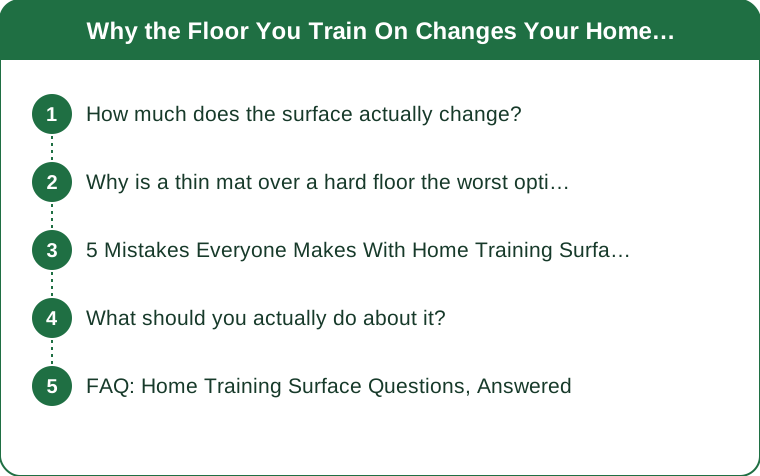
How much does the surface actually change?
More than you would guess, and in ways that stack.
Every time your foot lands, the floor pushes back. A stiff surface returns that force quickly and predictably. A soft surface absorbs some of it and returns the rest late and unevenly, which your nervous system has to correct for mid-movement.
On a squat or a deadlift that correction is small. On a single-leg movement it is the whole exercise. A split squat on thick carpet is a balance drill with a strength component, and a split squat on a hard floor is a strength exercise. Both are useful. They are not the same thing, and doing one while thinking you are doing the other is why progress stalls.
Then there is grip. Carpet grips too well in one direction and not at all in another - your sock slides on the pile while your shoe catches, which is why lateral work feels wrong on carpet regardless of footwear.
And there is noise, which sounds trivial and is not. If jumping wakes the baby or annoys the downstairs neighbour, you stop jumping. The surface decided that, not you.
Why is a thin mat over a hard floor the worst option?
Because it gives you the downsides of both and the benefit of neither.
A standard 6mm yoga mat over tile or laminate compresses under a heel strike, so you lose some of the clean force return of the hard floor. It does not compress enough to meaningfully cushion impact, so your joints still take most of it. And it moves - a mat that shifts even a centimetre under a lunge is a genuine instability you are unconsciously bracing against.
The mat also lies to you about what is underneath. People do jumping work on a mat over concrete believing the mat is doing something. At that thickness, on that surface, it is doing almost nothing for impact.
This is worth knowing because the thin mat is the default. It is what most people own, it is what most home workout videos show, and it is the single most common home training surface there is.
For floor work - core, stretching, kneeling movements - it is exactly right. For anything on your feet involving load or impact, it is the wrong tool and it is in the way.

5 Mistakes Everyone Makes With Home Training Surfaces
1. Training on carpet and blaming their balance. Wobbling in a single-leg RDL on a thick rug is not a balance deficit, it is an unstable surface. Test it once on a hard floor before you decide you have a weakness to fix.
2. Putting the heavy work where the floor is nice. People set up in the living room because it looks better, then avoid loading anything because they are worried about the hardwood. The garage floor you dislike is usually the better training surface.
3. Assuming a mat solves impact. It does not, at yoga mat thickness. If you want to jump indoors on a hard floor you need something in the region of 20mm of dense rubber, not 6mm of foam.
4. Ignoring what the floor does to footwear choice. Barefoot is excellent on a stable hard floor and a bad idea on carpet, where the pile changes how your toes spread and grip. Most people never connect the two.
5. Training in a spot too small for the movement and shortening the movement to fit. This is the sneakiest one. Lunges get shorter, steps get narrower, and the exercise slowly turns into something else while you keep calling it by its original name.
What should you actually do about it?
Match the surface to the category, and stop trying to make one spot do everything.
Pick your hardest surface for loaded standing work. Squats, deadlifts, presses, single-leg work. Stable and predictable beats comfortable every time here. Tile, laminate, hardwood, garage floor - whatever is stiffest.
Use the mat for floor contact only. Core work, stretching, kneeling, anything where the mat is between you and the ground rather than under a landing.
If you jump indoors, invest in the surface rather than the shoe. Two or three interlocking rubber gym tiles, 20mm or more, cost less than a pair of trainers and change what is available to you. They also solve most of the noise problem, which is what was actually stopping you.
If carpet is all you have, choose exercises that suit it rather than fighting it. Bilateral work, tempo work, isometrics, and anything where you are not asking the floor for a fast honest answer. Save the single-leg and lateral work for outdoors or the gym.
And check the space before the season changes. Autumn is when home training volume goes up because the evenings close in. The spot that worked for a bit of stretching in July becomes your main training space in October, and it is worth deciding that deliberately rather than discovering it in November.
FAQ: Home Training Surface Questions, Answered
Will heavy dumbbells damage a hardwood floor?
Dropping them will. Standing on them will not. A single rubber tile or an old mat placed where the weights get set down protects the floor without changing the surface you are standing on, which is the combination you want.
Is training on grass outdoors a good alternative?
For conditioning and bodyweight work, yes, and it is excellent for impact. For loaded or single-leg strength work, grass is soft and uneven, so it has the same instability issue as carpet with the added variable of the ground being slightly different every session.
Do I need different shoes for different rooms?
Most people need one flat, firm-soled shoe and the option of bare feet. Cushioned running shoes are the poorest choice for loaded home training on any surface, because they add a second layer of compression on top of whatever the floor is doing.
TL;DR:
- The floor changes force return, stability, and noise, and all three change which exercises you quietly avoid.
- A thin mat over a hard floor is the worst of both worlds for standing work and the right tool for floor work.
- Do loaded and single-leg work on your stiffest surface; if you jump indoors, buy 20mm rubber tiles rather than better shoes.
- On carpet, choose exercises that suit it instead of fighting it.
Home training plateaus are usually blamed on equipment or motivation. Before you buy anything else, spend a session doing the same movements in two different rooms and notice how differently they go. The floor has been making decisions for you.
Keep Reading
This article is for general informational purposes only and is not medical advice. It is not a substitute for professional diagnosis or treatment. Always consult a qualified healthcare provider about your individual situation, especially before making significant changes to your diet or exercise routine.