Wall Pilates: The Home Workout Trend That's Actually Good
Quick Answer: Wall Pilates is regular Pilates performed with a wall as your support, feedback tool, and resistance surface. It works because the wall tells you instantly when your spine or pelvis cheats — and it lets you scale a move up or down without buying a single piece of equipment. Ten focused minutes a day, five days a week, is enough to feel a difference in about three weeks.
Every viral fitness trend earns skepticism. Most deserve it. But wall Pilates survives scrutiny, and the reason is almost boring: the wall isn’t a gimmick, it’s feedback, support, and resistance in one free apparatus that already exists in every room you own.
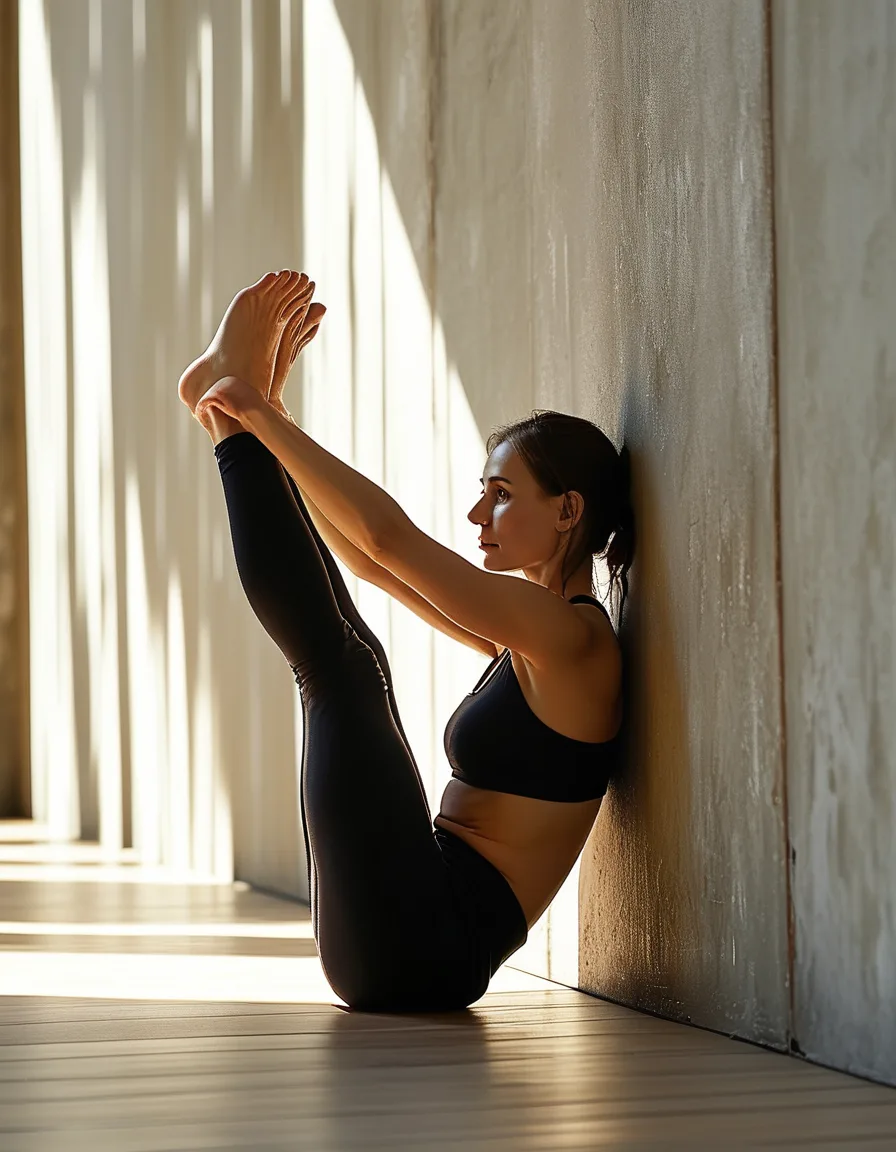
You’ve probably scrolled past the videos — someone in a small apartment, legs pressed vertically against drywall, looking suspiciously serene. Then you try it, and forty seconds into a legs-up core series you discover the serenity was editing.
Here’s why the wall works, which moves are worth your time, and the third mistake in the list below is one even experienced instructors make.
What Is Wall Pilates, Exactly?
Wall Pilates is mat Pilates with one addition: a vertical surface used as a reference point, a support, or a resistance target. Nothing about the principles changes. You’re still working spinal articulation, core control, breath, and precision. The wall just makes those things measurable.
Traditional Pilates studios solve this problem with a reformer — a $3,000+ machine whose springs give you resistance and whose carriage gives you feedback. The wall does a rougher version of both jobs for free. It’s not equivalent. It is, however, available at 6am in a studio apartment.
Why Does the Wall Actually Help?
The wall gives your body a reference point you can feel. In floor Pilates, your instructor tells you your ribs are flaring. Against a wall, your ribs tell you — you feel the gap open behind your back, and you correct it without anyone watching.
That’s the alignment half. The other half is load. Pressing into a wall creates isometric resistance you control entirely with your own effort, which means the same move scales from “recovering from a rough week” to “genuinely hard” without changing anything but intent.
For beginners, the wall is support: it holds your legs up so your core doesn’t have to do two jobs at once. For everyone else, it’s leverage. Same wall, opposite purposes.
Wall Roll-Downs: The Spinal Articulation Move
Stand with your back against the wall, feet about 6 inches forward, knees soft. Peel your spine off the wall one vertebra at a time — head, neck, upper back, mid back — then restack the same way in reverse.
The wall reveals exactly where your spine skips segments. Most people have one or two “blocks” that move as a unit instead of articulating. You’ll find yours in the first rep.
Do 6–8 slow reps, roughly 8 seconds down and 8 seconds up. It’s spinal articulation with a built-in teacher.
The Legs-Up Core Series
Lie on your back with your legs vertical against the wall, heels resting lightly. From here, run three moves: chest curls (10 reps), toe reaches (10 reps), and scissors (10 each side).
Because the wall stabilizes your legs, your core does pure, undistracted work. Nothing is helping you cheat with momentum. The series looks deceptively gentle and is honestly humbling — most people tap out around rep 8 of the toe reaches the first week.

Wall Sits Meet Pilates
Slide down into a wall sit — thighs parallel to the floor, knees stacked over ankles — and then add Pilates layers on top: slow arm circles, heel raises, or single-knee floats.
Your thighs burn while your core coordinates a second task. Hold for 30–45 seconds with the added movement. This is where the “the wall is just for beginners” opinions go to die.
Glute Bridges With Feet on the Wall
Lie on your back, plant your feet flat on the wall with knees at roughly 90 degrees, and bridge up slowly — 3 seconds up, 1 second hold, 3 seconds down.
The angle intensifies hamstring and glute work well beyond floor bridges, because your feet are pushing horizontally instead of just pressing down. Three sets of 10 and you’ll respect the trend.
5 Mistakes Everyone Makes With Wall Pilates
- Going fast. Wall Pilates rewards control, not reps. If you can do 20 roll-downs in a minute, you’re swinging, not articulating.
- Letting the low back arch off the wall. In legs-up work, your lumbar spine should stay heavy. If daylight appears under it, bend your knees slightly and rebuild.
- Pushing into the wall with your neck. This is the one even experienced people miss. When a move gets hard, the head presses back for extra leverage. That’s your neck paying your core’s bill — keep the back of your skull light.
- Choosing the wrong wall. Baseboards, radiators, and picture rails all change your alignment. You want flat drywall and a floor you’re not sliding on.
- Treating it as a full program. Wall Pilates is excellent core and mobility work. It is not cardio, and it is not progressive strength training. Pair it with walking and something that loads your body heavily twice a week.
Who Is Wall Pilates Best For?
It genuinely suits three groups: people with almost no floor space, people returning to movement after a break who need the support, and people who already train and want a low-cost mobility session on off days.
If you have an existing back, neck, hip, or knee condition — or you’re pregnant or recently postpartum — get a physical therapist or a certified instructor to look at your form before you build a habit around it. The wall is forgiving, but “free and convenient” is not the same as “appropriate for every body.” Sharp pain, numbness, or tingling means stop and see a professional, not push through.
How to Build a 10-Minute Session
Minute 0–2: wall roll-downs, 6–8 reps. Minute 2–5: legs-up core series, one round of all three moves. Minute 5–7: wall sit with arm circles, two holds of 40 seconds. Minute 7–10: glute bridges, three sets of 10, then one final roll-down to finish.
Do that five days a week. If you’d rather train in something that doesn’t slide or ride up mid-bridge, a pair of squat-proof high waist leggings makes the floor work considerably less annoying — the wall already gives you enough feedback without your waistband joining in.
Mini FAQ
Is wall Pilates as effective as reformer Pilates?
For core control, spinal articulation, and mobility, it gets you a meaningful share of the benefit. For progressive loaded strength, no — a reformer’s springs offer calibrated resistance the wall can’t reproduce. Think of wall Pilates as excellent maintenance and skill work rather than a full substitute.
How long before I see results from wall Pilates?
Most people notice better core awareness and less morning stiffness within 2–3 weeks of daily 10-minute sessions. Visible changes in muscle definition take longer, generally 8–12 weeks, and depend far more on your overall activity and nutrition than on the wall.
Can complete beginners start with wall Pilates?
Yes — it’s one of the better entry points, because the wall supports your legs and gives you constant alignment feedback. Start with roll-downs and the legs-up series only, keep sessions to 10 minutes, and add wall sits and bridges after your first two weeks.
TL;DR:
- The wall gives alignment feedback and scalable resistance for free — that’s why the trend held up.
- Four moves cover it: roll-downs, legs-up core series, loaded wall sits, feet-on-wall glute bridges.
- Ten minutes a day, five days a week; expect better core awareness in 2–3 weeks.
- Go slow, keep the low back heavy, and don’t push with your neck.
- It’s core and mobility work, not cardio or heavy strength — pair it with both.
Trends fade. This one earns a permanent spot next to any flat wall you own.
Keep Reading
This article is for general informational purposes only and is not medical advice. It is not a substitute for professional diagnosis or treatment. Always consult a qualified healthcare provider about your individual situation, especially before making significant changes to your diet or exercise routine.