How to Stay Motivated to Work Out at Home
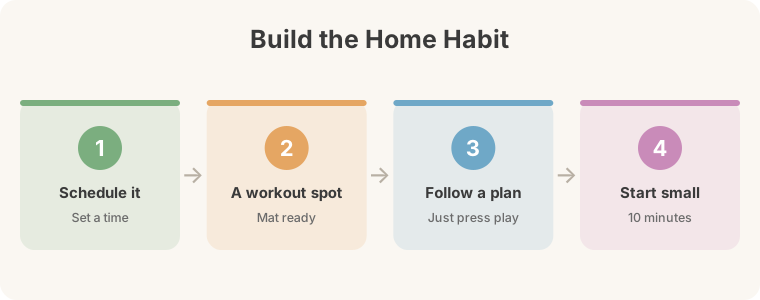
Quick Answer: Home workout motivation comes from design, not willpower. Pick a fixed time anchored to an existing habit, keep a mat permanently out, follow a plan so you never have to decide what to do, and set a 10-minute minimum on bad days. Structure you build yourself replaces the structure a gym would have imposed.
Working out at home is convenient, free, and comfortable. It is also the single easiest workout on earth to skip, because the couch is right there and nobody is expecting you anywhere.
That’s not a character flaw. A gym gives you a class time, a commute you’ve already committed to, and other people who notice whether you showed up. Take all three away and something has to replace them.

Why Are Home Workouts So Easy to Skip?
Because every barrier that gets you out the door is also the barrier that keeps you committed once you’re through it.
There’s no sunk cost — you didn’t pay for the class or drive 15 minutes. There’s no social contract — nobody notices your absence. There’s no environmental cue — your living room says “sit down” far more loudly than it says “do burpees.”
And there’s a decision cost most people underestimate. At a gym you follow whatever the class is. At home you have to choose the workout, find it, clear space, and start — four separate decisions before a single rep. Every one of those is a place to quit.
The fix is to remove decisions rather than to summon motivation. Design beats willpower, and it isn’t close.
How Do You Build a Home Workout Habit That Sticks?
1. Anchor it to something you already do
“Sometime today” is not a plan. “Right after my morning coffee” is, because coffee already happens with total reliability and it drags the workout along behind it.
Pick an anchor that happens every single day at roughly the same time: after coffee, after the school drop-off, immediately after logging off work. The anchor matters more than the hour.
2. Leave the equipment out
A mat rolled up in a closet adds three steps. A mat already unrolled on the floor adds zero — and it functions as a visual cue every time you walk past it.
This sounds trivial. Habit research keeps finding it isn’t: friction of a few seconds reliably changes whether behaviors happen. Leave the mat down. Leave the dumbbells visible. Set your shoes by the door.
3. Follow a plan so you never have to choose
Decision fatigue is the quiet killer of home training. Pick a program, a YouTube series, or an app, and let it tell you what today is. Press play, don’t deliberate.
Even a written list on the fridge — Monday lower, Wednesday upper, Friday cardio — removes the biggest source of at-home drop-off.
4. Set a 10-minute minimum, not a 45-minute goal
On the days you don’t want to, the deal is: ten minutes, then you’re allowed to stop.
You’ll finish the full workout maybe 70 percent of the time, and on the other 30 percent you still did ten minutes instead of zero. More importantly, the streak survives — and a streak is much easier to continue than to restart.
5. Make it something you’d choose
If you hate HIIT, stop programming HIIT. The best home workout is the one you’ll do 40 times this year, not the one that’s theoretically optimal and you’ll do six times.
Music matters more at home than at a gym, where the room supplies energy. Build a playlist you actively want to hear.
6. Get some form of accountability
A friend you text after each session. A shared calendar. A tracker on the wall you mark with an X. A group chat. Even a spreadsheet.
The mechanism doesn’t matter; being observed does — including by your own record.

5 Mistakes Everyone Makes with Home Workouts
- Planning for the best version of yourself. A six-day plan written on a motivated Sunday collapses by Wednesday. Write the plan for your worst week, not your best one. Three days you actually do beats six you don’t.
- Working out wherever there’s space today. A rotating location gives your brain no cue. Pick one spot — even a 6x6 corner — and always use it.
- Wearing whatever’s nearest. Actually changing into workout clothes is a psychological switch, and it’s most powerful precisely when there’s no gym to signal the transition. A pair of high waist leggings that fit properly does real work here; it’s hard to feel like you’re mid-workout in yesterday’s pajamas.
- Treating a missed day as a failed program. Missing one session is normal. Missing one and then quitting is the actual problem. The rule that works: never miss twice.
- Having no way to see progress. Without a gym mirror, weights going up, or classmates to compare against, home training can feel like it isn’t working. Track something — reps, time, how many sessions this month — or you’ll conclude nothing is happening when it is.
Mistake four is the one that ends more home routines than lack of motivation ever has.
FAQ
How long should a home workout be?
20–30 minutes is enough for most people to make real progress if the effort is honest. Frequency beats duration — four 25-minute sessions do more than one heroic 90-minute one.
What if I keep losing motivation after two weeks?
Two weeks is usually when novelty runs out and the habit hasn’t formed yet. That’s exactly when the 10-minute minimum earns its keep — it lowers the bar below your motivation instead of relying on motivation to clear the bar.
Do I need equipment to work out at home?
No. Bodyweight training covers strength, and a single set of adjustable dumbbells covers almost everything else if you want to add load later. Start with what you have; equipment is not what’s stopping anyone.
TL;DR:
- Home workouts fail on structure, not willpower — so build the structure
- Anchor the session to a habit you already do reliably
- Leave the mat out; remove every second of friction
- Follow a plan so you never decide what to do
- 10-minute minimum on bad days; never miss twice
- Track something so progress is visible
This article is for general wellness purposes only and isn’t medical advice.
Keep Reading
This article is for general informational purposes only and is not medical advice. It is not a substitute for professional diagnosis or treatment. Always consult a qualified healthcare provider about your individual situation, especially before making significant changes to your diet or exercise routine.