The Two-Square-Meter Gym: Home Workouts in Genuinely Small Spaces
Quick Answer: The real footprint of an effective home workout is one yoga mat — about 2m × 1m. Squats, push-ups, stationary lunges, planks, bridges, and the entire resistance-band catalog all fit inside it. Everything else is storage engineering: a doorway pull-up bar, bands on hooks, one pair of adjustable dumbbells replacing five fixed pairs, and the mat rolled in a corner or flat under the couch.
Every home gym article you’ve read assumes a garage.
You have the space between the couch and the bookshelf, and it’s roughly the size of a bath towel.
Here’s the thing nobody says out loud: the garage was always optional. The effective home workout has a footprint of one mat, and the rest of the problem is storage and exercise selection.
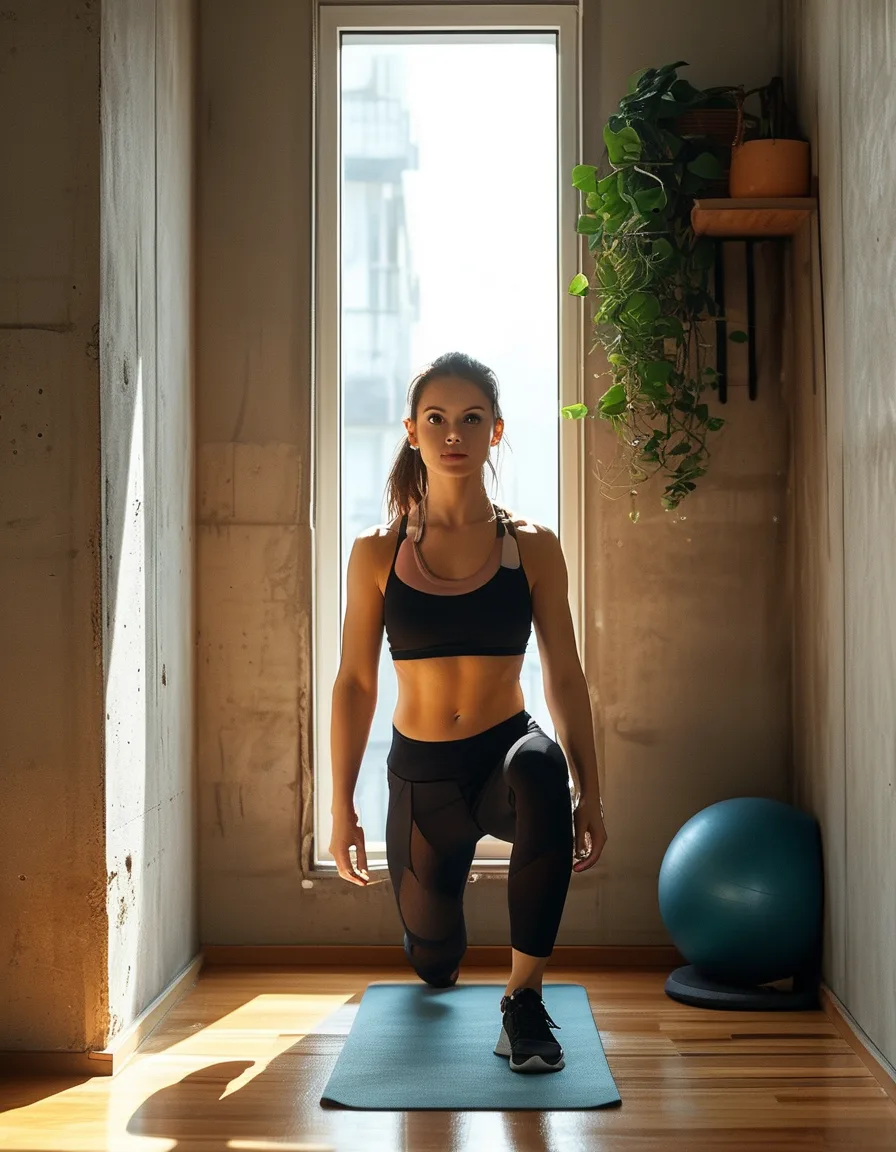
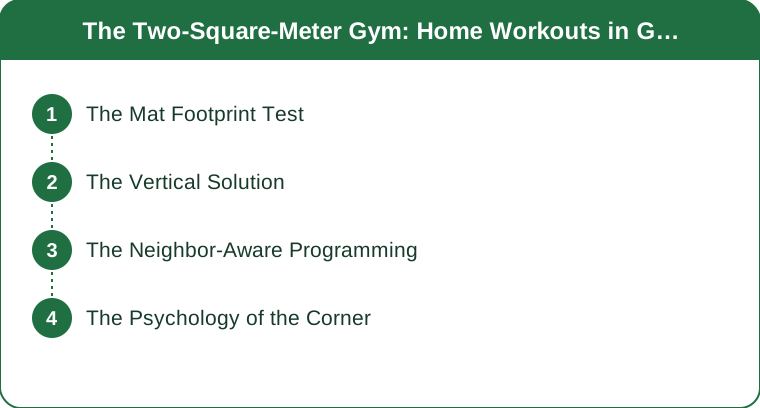
How much space do you actually need to work out?
Run the mat test: if a yoga mat fits, the gym fits.
Inside 2m × 1m you can do bodyweight squats, push-ups, stationary lunges and split squats, planks and side planks, glute bridges and hip thrusts, dead bugs, bird dogs, mountain climbers, and every resistance band exercise there is.
That list is enough to train every major muscle group. It’s not a compromise program — it’s most of what a general fitness routine consists of anyway.
The exercises that genuinely don’t fit have stationary siblings with the same benefit:
| Doesn’t fit | Fits, same job |
|---|---|
| Walking lunges | Stationary lunges, split squats |
| Broad-jump burpees | In-place burpees, squat-to-stand |
| Bear crawls | Bear-crawl holds, shoulder taps |
| Running | Bands, tempo work, step-ups on a stair |
Nothing on the right column is a downgrade. Several are harder.
Where do you store home gym equipment in a small apartment?
Vertically, and in the edges of rooms you’re already not using.
- A doorway pull-up bar. Zero floor footprint, and it’s the single best upper-body tool available at home. $25–$40.
- Bands on hooks. A set of loop and tube bands hangs on two hooks behind a door and covers essentially the entire resistance range for accessory work. $20–$40.
- Adjustable dumbbells. The single best investment for a small space — one pair replaces five or six fixed pairs and occupies about the footprint of a shoebox. They’re the most expensive item here ($150–$400) and the only one that genuinely changes what’s possible.
- The mat. Rolled in a corner, or stored flat under the couch or bed, which is the version that actually stays tidy.
Total storage requirement: a closet’s worth of edges. Nothing needs a dedicated room.

How do you work out without annoying your neighbors?
Apartment dimensions include the ceiling below you, and this is the constraint most home-gym advice ignores completely.
The silent-workout doctrine:
- Tempo work over jumps. A squat lowered over 4 seconds and driven up over 1 is harder than a fast one and makes no noise at all.
- Isometrics. Wall sits, plank holds, split-squat holds. Silent by definition and genuinely demanding.
- Bands instead of plyometrics. Bands provide resistance without impact and without dropped weight.
- A rug under the mat for sound damping — a thick rug plus a mat kills most of the residual thump from footwork.
- Daytime hours diplomacy. Whatever you do, doing it at 6:30 a.m. or 10 p.m. is where complaints come from.
The convenient part: the quiet program is also the joint-friendly one. Low-impact, controlled-tempo training is what most people over 30 should be doing more of anyway. The neighbor constraint pushes you toward better programming.
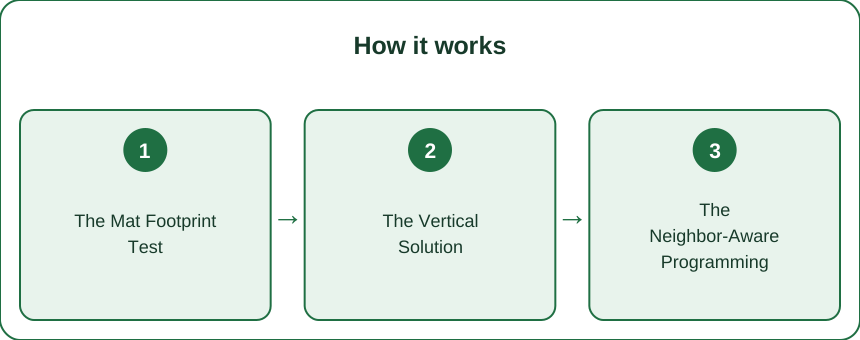
Why does having a designated corner matter so much?
Because the real obstacle in a small space isn’t square meters. It’s that the workout has no address.
When your training happens in “the living room,” it competes with everything else the living room is for. You have to clear space, retrieve equipment, and mentally convert the room before you start — three small frictions that reliably win on a tired Tuesday.
A designated corner — even one square meter, with the mat visible — changes that. The mat being out is a visual cue, and the cue does the scheduling. You don’t decide to work out; you walk past the corner and the corner reminds you.
This is standard environment design scaled down to studio-apartment reality. It’s the highest-return change in this entire article and it costs nothing.
Two square meters is fully sufficient. Give it a name.
5 Mistakes Everyone Makes
- Waiting for a bigger space. The mat-sized program works now. The garage version isn’t coming, and if it does you’ll have already built the habit.
- Buying fixed dumbbells to save money. Five pairs cost more in total, take ten times the space, and you outgrow the light ones. Adjustables are cheaper by the second year.
- Storing everything out of sight. Perfectly tidy equipment is equipment you forget you own. The mat should be visible.
- Programming jumps in an apartment. It’s the fastest route to a complaint and it isn’t necessary — tempo and isometrics are harder anyway.
- Treating small space as a reason to skip legs. Split squats, tempo squats, and single-leg work in a 2m² box will humble anyone. Space was never the limiting factor there.
FAQ
Can you really get fit in a small apartment?
Yes. A yoga mat’s worth of floor plus bands and one pair of adjustable dumbbells covers strength training for every major muscle group, and progression comes from load, tempo, and volume rather than from space. The genuine limitations are running and heavy barbell work — everything else in a general fitness program fits.
What’s the best equipment for a small home gym?
In order of value per square inch: resistance bands, a doorway pull-up bar, and one pair of adjustable dumbbells. That combination handles pushing, pulling, hinging, squatting, and accessory work for well under $500 total, and all of it stores in a closet or behind a door. A mat is the fourth item and the one you’ll use every session.
How can I work out at home without disturbing downstairs neighbors?
Replace jumping and dropped weights with tempo work, isometric holds, and band resistance — all of which are silent and often harder. A thick rug under your mat absorbs most remaining impact, and keeping sessions inside normal daytime hours resolves nearly everything else. As a bonus, that programming is also lower-impact on your joints.
TL;DR:
- If a yoga mat fits, the gym fits — 2m × 1m covers squats, push-ups, lunges, planks, bridges, and all band work.
- Exercises that don’t fit have stationary versions with the same benefit.
- Store vertically: doorway pull-up bar, bands on hooks, mat under the couch.
- Adjustable dumbbells are the single best small-space investment.
- Go quiet: tempo work, isometrics, bands, a rug under the mat, daytime hours.
- The quiet program is also the joint-friendly one.
- A named corner with the mat visible beats a bigger space with no address.
Keep Reading
This article is for general informational purposes only and is not medical advice. It is not a substitute for professional diagnosis or treatment. Always consult a qualified healthcare provider about your individual situation, especially before making significant changes to your diet or exercise routine.