Home Workouts: Morning or Evening — Which Actually Sticks?
Quick Answer: Morning, for home workouts specifically — not because the physiology favors it, but because it removes the failure mode that kills home training. Late afternoon and evening genuinely produce slightly better performance: higher core temperature, better strength output, better power. But home workouts fail from competition with the rest of the day, not from suboptimal timing, and a morning session has almost nothing to compete with. The best time remains the one you actually do; if you have tried both and neither stuck, try morning first.
You know evening is meant to be better for performance, and you also know that you have not done an evening workout since July.
Both of these are true and only one of them matters. The research on optimal training time was largely conducted on people who were definitely going to train — it answers a question about performance, not about whether the session happens. For home workouts, that second question is the entire problem, and the mechanism in the third section is why.

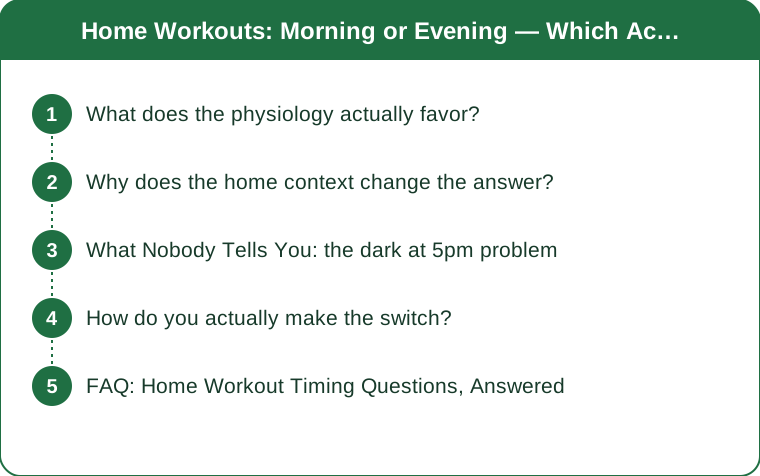
What does the physiology actually favor?
Late afternoon to early evening, roughly 4pm to 7pm, on most performance measures.
Core body temperature peaks in the late afternoon, which improves muscle compliance, nerve conduction speed, and enzymatic efficiency. The measured effects on strength and power output are real but modest — typically a few percent.
Reaction time and coordination are also better later in the day, which matters more for complex movements than for bodyweight circuits.
Perceived exertion is lower in the afternoon for the same objective work, so sessions feel easier.
Against that:
Morning training shows better adherence in the research, consistently. People who train in the morning are more likely to still be training months later.
Morning exercise may support sleep quality and circadian alignment slightly better, particularly combined with morning light exposure.
The performance difference is small enough to be irrelevant for most people’s goals. A few percent on strength output matters if you are competing. It does not matter if you are trying to be someone who trains three times a week.
The honest summary: evening is marginally better if you train; morning makes it more likely you train. For home workouts, that trade is not close.
Why does the home context change the answer?
Because home workouts fail differently from gym workouts, and the failure mode is timing-sensitive.
A gym workout has structural protections. You have travelled there, you have paid, you are surrounded by people doing the same thing, and you cannot easily be interrupted. None of that applies at home.
A home workout competes directly with everything else in your environment, and the competition gets stronger as the day goes on. By 7pm you have a household, a phone, dinner, tiredness, and a sofa within ten feet. The workout has to win against all of it, every day, using willpower alone.
At 6:30am, it competes with almost nothing. The house is quiet, nobody needs anything, no work has arrived, and the day has not yet produced any reasons.
Decision fatigue is the specific mechanism. Willpower and decision quality degrade measurably across a day. A choice made at 6am is made with a full tank; the same choice at 7pm is made after a day of expending it. This is why the same person can be reliable in the morning and unreliable at night with no change in motivation.
There is also a scheduling asymmetry. Evening commitments are unpredictable and morning ones are not. Work runs late, someone needs collecting, a friend calls. Very little arrives unexpectedly at 6:30am, which means a morning slot holds its shape week to week in a way an evening slot does not.

What Nobody Tells You: the dark at 5pm problem
Here is what is about to happen to a lot of evening home routines, and it happens every year.
As the evenings get darker, evening home workouts collapse at a rate that has nothing to do with motivation.
Several things stack up at once. Darkness at 5pm is a strong biological cue toward winding down — melatonin production begins earlier, and the pull toward rest arrives while there is still a workout on the schedule. The environment changes too: a living room that felt like a workout space in July light feels like an evening room under a lamp in October.
And because home workouts have no external commitment, there is nothing to override the pull. A gym membership creates a sunk cost and a booked class creates an obligation. A mat in the corner creates neither.
People almost always interpret this as a personal failure. It is a predictable seasonal effect, it happens to most people who train at home in the evening, and it happens on roughly the same timeline every year.
Three things that actually help:
Move the session earlier for the season. Not necessarily to 6am — a lunchtime or 4pm slot preserves most of the performance advantage while landing before the light goes. Many people find this works better than either extreme.
If you keep the evening slot, fix the light. Bright light in the room during the workout, and dimmer light afterwards. Working out in a dim room is fighting your own physiology.
Attach the session to something that already happens rather than to a time. After the last work call. Before dinner. Immediately on getting home, without sitting down first — that last one matters, because sitting down is where evening workouts actually die.
The morning version has a seasonal problem too, and it is worth naming: dark mornings make getting up harder, and a 6am alarm in November is meaningfully different from one in August. The counter is light — a lamp on a timer or a wake-up light — plus not moving the wake time by more than about 30 minutes across the season.
How do you actually make the switch?
If you are moving to mornings, do it gradually and structurally rather than by resolution.
Shift your wake time by 15 minutes a week, not an hour at once. A sudden 6am alarm from a 7:30 baseline fails within a week, and the failure feels like evidence you are not a morning person.
Lay everything out the night before. Mat down, clothes out, the session already chosen and written on paper. Every decision you remove from the morning is one you cannot get wrong at 6am.
Keep the first two weeks short. Fifteen to twenty minutes. You are building the habit, not the fitness; the fitness follows once the habit exists. A 45-minute morning plan on day one is a plan to quit by day four.
Warm up longer than you would in the evening. Body temperature is at its lowest and tissue is stiffest first thing, so give it eight to ten minutes rather than three, and avoid maximal efforts in the first ten minutes. This is a genuine physiological difference and the main real cost of training early.
Protect the bedtime. A morning routine built on less sleep is borrowing from the thing that makes training work at all. If the session requires an hour less sleep, it will not survive and it should not.
And keep the honest fallback in place: if you have a reliable evening routine that has survived a winter, do not change it. This advice is for the majority whose evening routine has not.
FAQ: Home Workout Timing Questions, Answered
Is training first thing on an empty stomach a problem?
For sessions under about 45 minutes at moderate intensity, no — most people are fine. For longer or harder sessions, something small beforehand helps: half a banana, a piece of toast. If you feel lightheaded or notably weak, that is the signal to eat first rather than to push through.
What about a lunchtime workout?
Frequently the best compromise and consistently underrated. It preserves much of the afternoon performance advantage, it does not require an early alarm, and it lands before the evening’s competing demands begin. The constraint is whether your day allows it, not whether it works.
Does it matter if I am inconsistent about the time?
Somewhat. Training at roughly the same time helps your body anticipate it — there is measurable circadian adaptation to a regular training time — and, more practically, a fixed slot is a habit while a floating one is a daily decision. Consistency of time is a smaller factor than consistency of frequency, but it is not nothing.
TL;DR:
- Evening is marginally better for performance; morning is substantially better for adherence, and adherence is the whole problem at home.
- Home workouts fail from competition with the rest of the day, and that competition is near zero at 6:30am.
- Evening home routines predictably collapse as it gets dark at 5pm — that is seasonal, not a character flaw.
- Switch gradually: 15 minutes a week, everything laid out the night before, short sessions for the first fortnight, longer warm-up.
Pick the slot with the fewest competitors, not the one with the best numbers. The optimal session is the one that happened.
Keep Reading
This article is for general informational purposes only and is not medical advice. It is not a substitute for professional diagnosis or treatment. Always consult a qualified healthcare provider about your individual situation, especially before making significant changes to your diet or exercise routine.