Sweating Together: Home Workouts Built for Two
Quick Answer: Partner home workouts stick better than solo plans because cancelling on someone in the same room takes real effort. Use an I-go-you-go circuit format so one person works while the other rests, pair exercises so a single set of dumbbells serves both of you, and agree on one rule up front: no coaching unless it’s asked for.
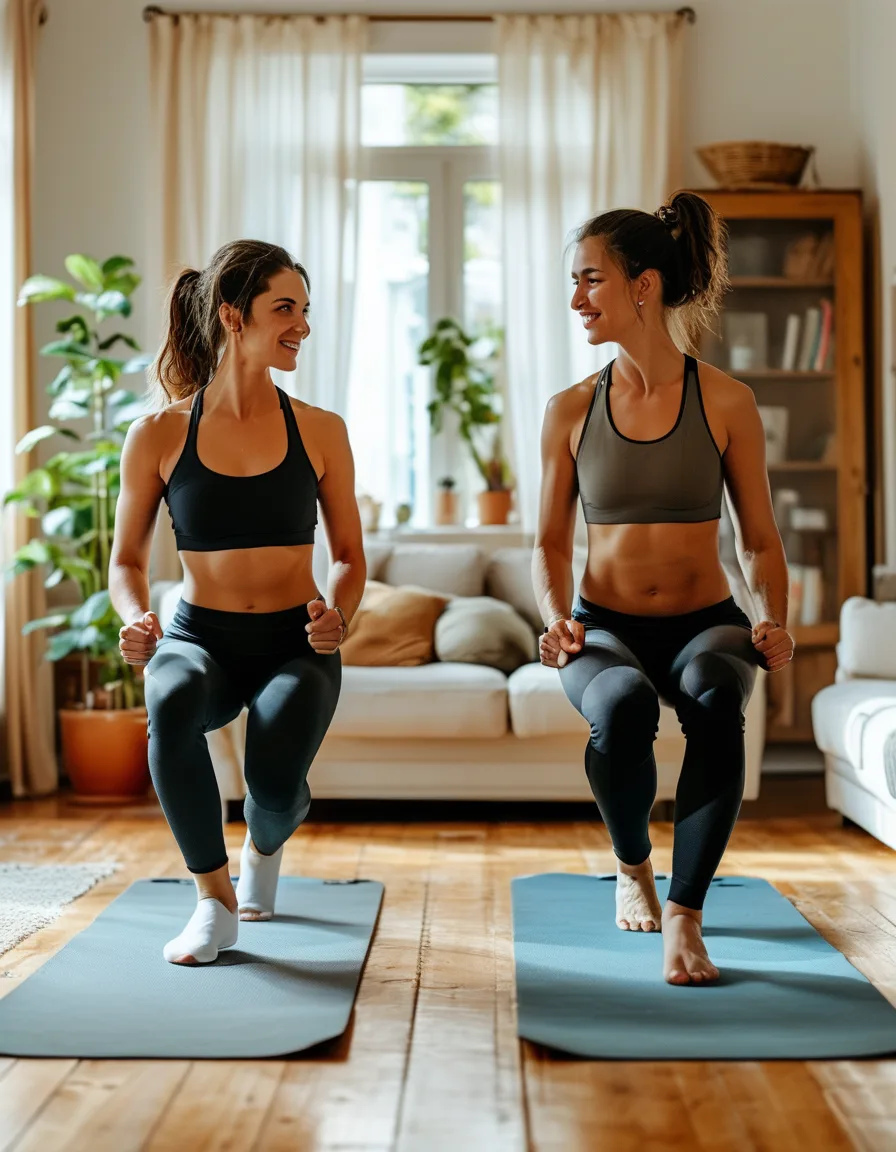
The home workout has a two-person version, and it has a genuinely better completion rate than either of your solo plans.
Not because it’s harder. Because it’s much more awkward to skip when the other person is already changed and standing in the living room.
Why Do Partner Workouts Actually Stick?
Three mechanisms, and the first one does most of the work.
Cancelling requires a conversation. Skipping a solo session is a private decision you make in about four seconds. Skipping a shared one means saying it out loud to someone who is already in their trainers, which is a much higher bar. Buddy-system research fairly consistently shows an adherence bump for exactly this reason.
The scheduling is already solved. Two people in one household share a calendar, a commute pattern, and an evening. Finding a mutual slot is trivial compared to coordinating with a gym friend.
There’s a witness. Mild, low-stakes accountability — someone noticing whether you did the last three reps — is surprisingly effective without being unpleasant.
The realistic target is 3 sessions a week, 30 to 40 minutes each. That’s frequent enough to see change and infrequent enough that it doesn’t start feeling like an obligation.
What Does a Two-Person Circuit Look Like?
The I-go-you-go format: one person works, one rests, then swap. It gives you built-in intervals and a built-in audience without any extra planning.
A simple 30-minute session:
- Warm-up, 5 minutes together — marching, arm circles, bodyweight squats, hip openers
- Round 1: Squats — 40 seconds on, swap, 3 rounds each
- Round 2: Push-ups (elevated on a sofa arm is a perfectly good regression) — 40 seconds on, swap, 3 rounds each
- Round 3: Row or reverse fly with whatever weight you have — 40 seconds on, swap, 3 rounds each
- Round 4: Plank hold — both at once, longest hold wins, stakes negotiable
- Cool down, 5 minutes — hamstring, hip flexor, chest stretches, 30 seconds each
Different fitness levels coexist fine here. Same exercise, individual intensities, shared timer. One person does full push-ups while the other does them elevated, and the circuit runs identically.
The plank competition is the only genuinely competitive element, and it’s worth keeping — it’s the part people actually look forward to.
How Do You Share One Set of Weights?
Pair a weighted exercise with a bodyweight one, then swap. The equipment never rests and neither of you waits.
- One person does dumbbell rows while the other does glute bridges
- One does goblet squats while the other does push-ups
- One does overhead press while the other holds a plank
This is why a two-person household gets roughly double the value from one pair of adjustable dumbbells. A single adjustable set covering 5 to 50 lbs replaces a rack and serves two people at different strength levels without any negotiation.
A resistance band or two adds the pulling exercises that dumbbells alone handle poorly, and costs very little.
5 Mistakes Everyone Makes Training With a Partner
1. Unsolicited form correction. This is the big one. Correcting your partner’s squat depth without being asked is a known domestic incident. Agree up front: coaching only on request.
2. Matching each other’s weights. Bodies are different sizes with different training histories. Using the same dumbbell out of pride is how one of you gets hurt and the other gets a pointless session.
3. Making it compulsory. The right to a solo session survives cohabitation. If it becomes an obligation, the adherence advantage evaporates — it should stay an offer.
4. Comparing progress curves. Two people starting together will progress at different rates for reasons neither of you controls. Celebrate asymmetric progress or the whole thing sours by week six.
5. Skipping the warm-up because you’re chatting. Easy to do when it feels social. Five minutes still matters, especially for the first session of the week.
The third one is worth taking seriously — the sessions that work best are the ones both people would have chosen independently.
How Do You Keep It From Getting Stale?
Rotate one variable at a time. Change the exercise selection every 4 weeks, or change the format — try 20 minutes of continuous circuits instead of the rest-and-swap structure.
Add a third day of something completely different: a walk, a follow-along class, a bike ride. Not everything needs to be strength work.
And treat it as a slot in the week rather than a fitness project. Done well, the shared session becomes the most reliably kept plan in the household — which is a slightly odd thing for a workout to be, and also the entire point.
A standard caveat: if either of you has a joint issue, a recent injury, or is coming back from a long break, get sensible advice before starting a new routine, and scale the first two weeks lower than feels necessary.
Mini FAQ
Do couple workouts actually work better than solo ones?
For adherence, generally yes. The training effect is the same as any comparable solo program — the advantage is that shared sessions get skipped less often, and consistency is what produces results.
What equipment do you need for partner home workouts?
One pair of adjustable dumbbells and a resistance band covers most of it. Pair a weighted exercise with a bodyweight one so a single set serves both people without waiting.
How do you train together at different fitness levels?
Same exercise, different intensity. One person does the harder variation or heavier weight while the other does a regression, on the same shared timer. The circuit structure stays identical.
TL;DR:
- Partner workouts stick because cancelling on someone in the room is genuinely harder.
- Use I-go-you-go circuits: 40 seconds on, swap, 3 rounds per exercise.
- Pair weighted with bodyweight moves so one set of dumbbells serves both of you.
- No coaching unless asked, don’t match weights, and keep it an offer rather than an obligation.
- Aim for 3 sessions of 30-40 minutes a week and rotate one variable each month.
The home gym’s best equipment was always the other person — scheduled, witnessed, and mildly competitive.
Keep Reading
This article is for general informational purposes only and is not medical advice. It is not a substitute for professional diagnosis or treatment. Always consult a qualified healthcare provider about your individual situation, especially before making significant changes to your diet or exercise routine.