Why Your Bodyweight Workouts Stopped Working — and the Progressive Overload Fix
Quick Answer: Bodyweight plateaus happen because people keep the same reps and form indefinitely instead of increasing difficulty. Progressive overload without weights works through tempo, range of motion, leverage changes, and unilateral variations — pick one lever and change it every 2-3 weeks.
You’ve done the same 3 sets of 15 push-ups for months and stopped seeing any change. That’s not a bodyweight training limitation — it’s a missing progression plan, the same problem that happens with weights if you never add load.

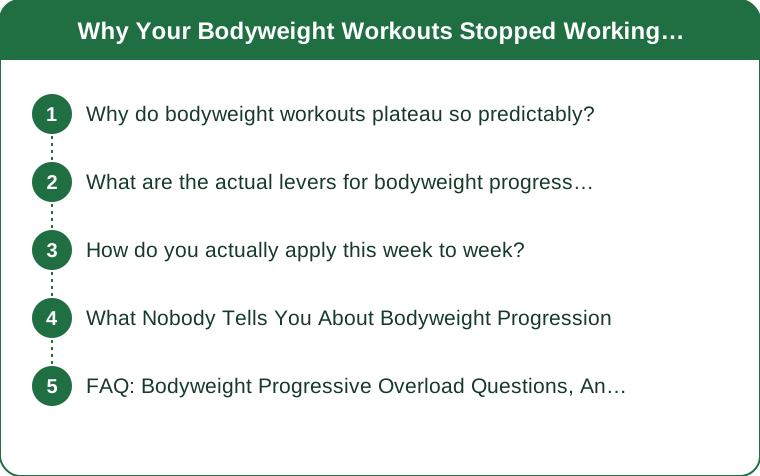
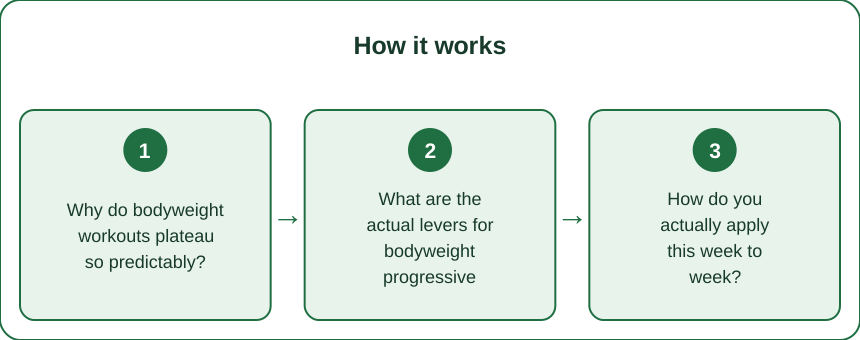
Why do bodyweight workouts plateau so predictably?
Because reps and sets alone have a ceiling — once your body adapts to a movement pattern at a given difficulty, doing more of the exact same thing produces diminishing returns, the same principle behind why lifters need to add weight over time.
Bodyweight training has an equivalent to “adding weight” — it’s just less obvious, which is why plateaus happen more often without anyone noticing the fix available.
What are the actual levers for bodyweight progressive overload?
Tempo: slowing the eccentric (lowering) phase to 3-4 seconds dramatically increases time under tension without changing the movement itself.
Range of motion: a deeper squat or a deficit push-up (hands elevated, chest dips lower) increases the work done per rep.
Leverage: moving hands or feet further from your center of mass (like an incline vs decline push-up) changes the effective resistance.
Unilateral variations: single-leg or single-arm versions of a movement roughly double the load on the working limb compared to the bilateral version.

How do you actually apply this week to week?
Pick one lever at a time and progress it over 2-3 weeks before adding another — trying to change tempo, range, and leverage simultaneously makes it hard to tell what’s working and often leads to form breakdown.
A simple sequence: standard push-up → slow-tempo push-up → deficit push-up → single-arm-assisted push-up, each held for a few weeks before advancing.
What Nobody Tells You About Bodyweight Progression
Most people plateau not because bodyweight training has a hard ceiling, but because they never structured a progression plan in the first place — they just repeated the same session indefinitely, which is functionally identical to a weightlifter never adding a single plate for a year.
The fix isn’t switching to weights — it’s applying the same overload logic weights use, just through different variables.
FAQ: Bodyweight Progressive Overload Questions, Answered
Can bodyweight training really build significant strength without any equipment?
Yes, for a large range of strength levels — advanced bodyweight variations (single-arm push-ups, pistol squats) are genuinely difficult and require substantial strength to perform with good form.
How do I know when to progress to the next variation?
When you can complete your target reps with good form and it no longer feels challenging in the last 2-3 reps, it’s time to add a progression lever.
Is slow tempo alone enough to keep progressing indefinitely?
No — tempo has diminishing returns past a point (very slow reps become more about control than strength). Combine it with range or leverage changes over time for continued progress.
TL;DR:
- Plateaus happen from repeating the same reps/form indefinitely, not a bodyweight ceiling
- Real overload levers: tempo, range of motion, leverage, unilateral variations
- Progress one lever at a time over 2-3 weeks before adding another
- The fix is a progression plan, not switching to weights
Pick one lever this week — slow your tempo down or try a single-arm variation — and give it 2-3 weeks before judging.
Keep Reading
This article is for general informational purposes only and is not medical advice. It is not a substitute for professional diagnosis or treatment. Always consult a qualified healthcare provider about your individual situation, especially before making significant changes to your diet or exercise routine.