The Best No-Equipment Home Workout
Quick Answer: The best no-equipment home workout is a full-body circuit: squats, push-ups, lunges, glute bridges, plank, and mountain climbers. Do 12–15 reps of each (30–45 seconds for planks), move between exercises with minimal rest, then rest 90 seconds and repeat for 3 rounds. That’s roughly 25 minutes and it covers every major muscle group.
No equipment. No gym. No problem whatsoever.
Your own bodyweight is a genuinely powerful training tool, and a well-designed no-equipment workout builds real strength. All you need is a patch of floor and about 25 minutes.

What Is the Best No-Equipment Home Workout?
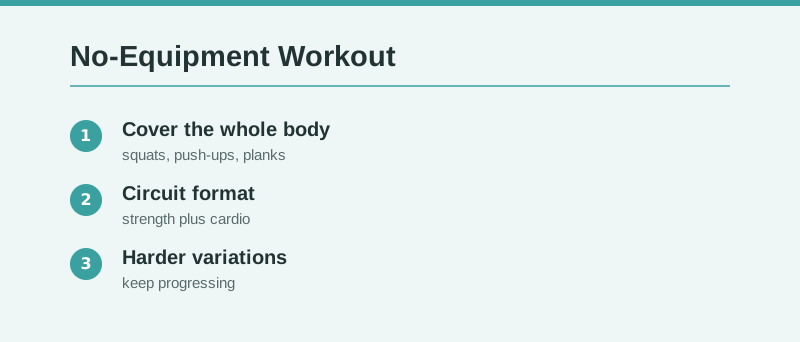
Here’s the circuit. Six exercises, three rounds, roughly 25 minutes.
1. Bodyweight squats — 15 reps. Feet shoulder-width, chest up, sit back as if reaching for a chair behind you. Knees track over toes. Descend for 3 seconds, stand up in 1.
2. Push-ups — 10–15 reps. Hands slightly wider than shoulders, body in one line from head to heels. On your knees is a completely legitimate version — better a clean knee push-up than a sagging full one.
3. Reverse lunges — 10 per leg. Step back, drop the back knee toward the floor, drive through the front heel to stand. Reverse lunges are kinder on the knees than forward ones.
4. Glute bridges — 15 reps. On your back, feet flat, lift the hips, squeeze hard at the top for 2 seconds, lower with control.
5. Plank — 30–45 seconds. Forearms down, hips level, glutes and abs braced. Quality over duration — a shaking 30 seconds beats a sagging 90.
6. Mountain climbers — 30 seconds. Push-up position, drive knees alternately toward your chest at a steady pace.
Move between exercises with minimal rest. Rest 90 seconds between rounds. Three rounds total.
Why Does the Circuit Format Work So Well?
Because it delivers two adaptations in one session. Moving exercise to exercise with little rest keeps your heart rate elevated, so you’re getting cardiovascular work while the individual exercises are doing the strength work.
It also solves the biggest problem with bodyweight training at home — that a straight set of 15 squats with two minutes rest isn’t very demanding. The circuit format is what turns simple moves into a properly challenging session.
Coverage matters as much as intensity. Squats and lunges for legs and glutes, push-ups for chest, shoulders and triceps, planks and mountain climbers for the core, glute bridges for the posterior chain. That’s every major muscle group. Skipping the posterior chain — the part you can’t see in the mirror — is the most common flaw in self-designed home workouts.
How Do You Keep Getting Stronger Without Weights?
This is the real question, and there are four levers.
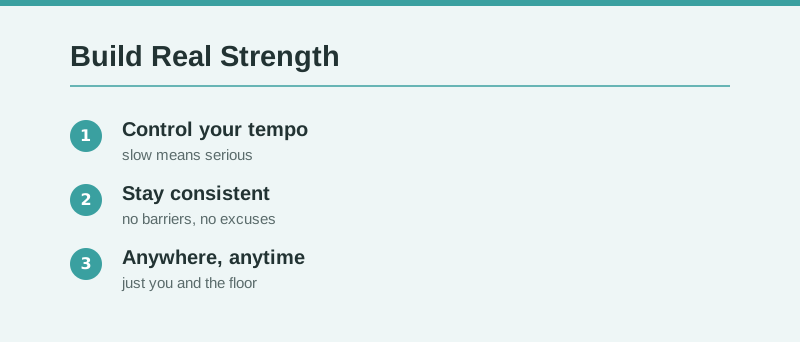
1. Slow the tempo. The easiest and most underrated. Lowering into a squat over 3–4 seconds, or controlling a push-up descent over 3, dramatically increases the stimulus with zero equipment. Tempo control turns simple moves into serious strength work.
2. Progress to harder variations.
- Squats → split squats → Bulgarian split squats → pistol squat progressions
- Knee push-ups → full push-ups → feet-elevated push-ups → archer push-ups
- Glute bridges → single-leg glute bridges
- Plank → plank with shoulder taps → long-lever plank
3. Reduce leverage. Elevating your feet on a chair during push-ups shifts more bodyweight onto your upper body. Changing angles is how bodyweight training adds “load.”
4. Add rounds or cut rest. Four rounds instead of three. Sixty seconds rest instead of ninety. Simple, effective, and it comes for free.
Pick one lever at a time. Changing all four at once means you can’t tell what worked.
What Nobody Tells You
Consistency beats programming. A mediocre workout done four times a week destroys a perfect one done twice a month. This is the single biggest determinant of results for home training, and nobody wants it to be the answer.
Bodyweight legs need creativity sooner than upper body. Your legs are strong; 15 squats stops challenging them fast. Single-leg work — split squats, step-ups on a stair, single-leg glute bridges — is where leg progress lives once bodyweight squats get easy.
You’ll plateau on push-ups around week 8. That’s the point to switch to feet-elevated or slow-tempo versions rather than just adding reps. Doing 40 push-ups is more of an endurance test than a strength one.
Twenty-five minutes is enough. Home workouts fail from being too ambitious more often than too easy. A 25-minute session you’ll actually start beats a 60-minute one you’ll skip.
How Often Should You Do It?
Three to four times a week, with at least one rest day between sessions in the first month. Bodyweight circuits are demanding enough that daily training doesn’t leave room to recover.
A workable week: Monday circuit, Tuesday walk, Wednesday circuit, Thursday off, Friday circuit, weekend as you like. If you also have access to dumbbells occasionally, the full-body dumbbell workout slots in nicely as a fourth session.
Expect noticeably better endurance in 2–3 weeks and visible strength changes around 6–8.
FAQ
Can you build real muscle without equipment?
Yes, particularly in the first year of training and especially in the upper body, where bodyweight provides genuine resistance. Progress slows sooner than with weights, which is why tempo and harder variations matter — they’re how you keep supplying a progressive stimulus.
How long should a no-equipment workout be?
Twenty to thirty minutes for a circuit like this one. Beyond about 40 minutes you’re mostly training endurance, which is fine if that’s the goal but isn’t the most efficient use of the time.
What if you can’t do a full push-up?
Start on your knees, or with hands elevated on a counter or sturdy chair — incline push-ups. Both are real training, and both progress to full push-ups within a few weeks of consistent work.
Is a bodyweight workout enough for legs?
For beginners, yes. Once bodyweight squats stop being challenging, shift to single-leg variations — split squats, step-ups, and eventually pistol progressions. Single-leg work is how you keep loading legs without any equipment.
TL;DR:
- Six-exercise circuit: squats, push-ups, reverse lunges, glute bridges, plank, mountain climbers.
- 12–15 reps each (30–45 sec planks), minimal rest between moves, 90 sec between rounds, 3 rounds.
- Roughly 25 minutes, covering every major muscle group.
- Progress by slowing tempo first — 3–4 second lowering phases.
- Then harder variations, changed leverage, more rounds, or less rest. One lever at a time.
- Single-leg work is how legs keep progressing without equipment.
- Three to four sessions a week; consistency matters more than the program.
Keep Reading
This article is for general informational purposes only and is not medical advice. It is not a substitute for professional diagnosis or treatment. Always consult a qualified healthcare provider about your individual situation, especially before making significant changes to your diet or exercise routine.