The 15-Minute Living-Room Workout You Can Do Before Your Coffee Gets Cold
Quick Answer: A 15-minute full-body living-room workout works: 2 minutes of warm-up, a 10-minute circuit of five bodyweight moves (40 seconds on, 20 off, twice through), and 3 minutes of cool-down. No equipment needed. Done three or four mornings a week, most people notice steadier energy and a stronger back within two to three weeks.
Here’s the truth nobody puts on a fitness poster: the best workout is the one you’ll actually do. And on a busy morning, that is very rarely a 90-minute gym session.
It’s fifteen minutes, in your living room, still half-awake, in whatever you slept in.
So make your coffee, let it sit, and let’s beat the clock.

Does a 15-Minute Workout Actually Do Anything?
Yes — and the reason is arithmetic rather than motivation.
Fifteen focused minutes, four mornings a week, is 52 hours of training a year. The hour-long session you keep postponing until you have time for it is, realistically, zero hours a year. Consistency beats intensity over any timeframe longer than a month, and it isn’t close.
There’s a physiological argument too. Bodyweight circuits with short rests keep your heart rate elevated while still loading the muscles, so you get a cardiovascular stimulus and a strength stimulus in the same fifteen minutes. That’s an efficient trade for a Tuesday morning.
What fifteen minutes won’t do is build serious maximal strength or prepare you for a marathon. What it will do is maintain mobility, build baseline strength, wake up a body that’s about to sit for eight hours, and keep the habit alive on weeks when nothing else is possible.
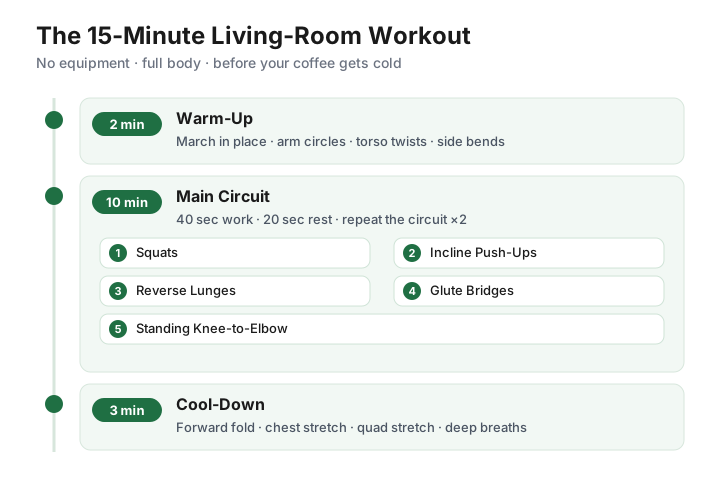
Here’s the whole routine at a glance:
The Warm-Up (2 minutes)
Don’t skip this. Cold muscles are cranky muscles, and morning bodies are stiffer than afternoon ones.
- March in place — 30 seconds
- Arm circles, forward then back — 30 seconds
- Gentle torso twists — 30 seconds
- Standing side bends — 30 seconds
You should finish feeling warmer, not tired. If you’re out of breath, you went too hard.
The Main Circuit (10 minutes)
Each move for 40 seconds, then rest 20 seconds. Complete the full circuit twice.
1. Squats
Feet about shoulder-width, sit back like there’s a chair behind you, knees tracking over your toes. Go as deep as feels controlled — depth improves over weeks. Aim for around 15–20 reps in your 40 seconds.
2. Incline Push-Ups
Hands on the couch arm or the coffee table, body in one straight line from head to heels. The higher the surface, the easier it is. No shame in the incline — it’s smart programming, not a compromise. Lower the surface over the weeks as it gets easier.
3. Reverse Lunges
Step back, drop the back knee toward the floor, drive up. Alternate legs. Reverse lunges are much kinder on knees than forward ones, which is exactly what you want first thing in the morning.
4. Glute Bridges
On your back, feet flat and close to your hips, drive through the heels and lift. Squeeze at the top for a full second. This is your body’s direct counter-move to a day of sitting, and most people can hit 20–25 reps.
5. Standing Knee-to-Elbow
Stand tall, bring opposite knee and elbow together, alternate at a brisk pace. A little cardio, a little core, and the move that finally convinces your nervous system you’re awake.

The Cool-Down (3 minutes)
- Forward fold — knees soft, let your head hang, 30 seconds
- Doorway chest stretch — forearm on the frame, step through, 30 seconds each side
- Quad stretch — 30 seconds each side
- Four slow breaths — in for 4, out for 6, 30 seconds
The exhale-longer-than-inhale pattern is what shifts you out of workout mode and into the rest of your day.
How Do You Make It Harder Over Time?
The routine stops working if it stays identical for six months. Progress it in this order:
- Slow the lowering phase. Take three seconds to descend in squats and push-ups. This is the easiest way to add difficulty with zero equipment.
- Lower the push-up surface. Coffee table, then a step, then the floor.
- Add reps. Track how many squats you get in 40 seconds and try to beat it monthly.
- Progress the single-leg work. Reverse lunges become Bulgarian split squats with your back foot on the couch.
- Add a third round. Twenty minutes instead of fifteen, once you have the base.
5 Mistakes Everyone Makes with Short Home Workouts
- Skipping the warm-up to save two minutes. Those two minutes are the difference between a productive circuit and a tweaked lower back at 7am.
- Rushing reps to hit a number. Twelve controlled squats beat twenty sloppy ones. The 40-second window is a container, not a target.
- Doing the identical workout for a year. Your body adapts in about six weeks. Progress something or it becomes maintenance.
- Not changing clothes. It feels like a shortcut and it isn’t — actually changing signals a mode switch, and high waist leggings that stay put beat sliding pajama bottoms through a set of lunges.
- Judging it against a gym session. This isn’t a compromised gym workout. It’s a different thing, doing a different job, and it’s the one you’ll still be doing in October.
FAQ
Is 15 minutes a day enough exercise?
For general health and baseline strength, a daily 15-minute circuit plus regular walking covers a lot of ground. For specific goals — significant muscle gain, endurance events — you’ll eventually need more volume, but it’s a genuinely solid foundation.
Should I do this every day or take rest days?
Three to four times a week is the sweet spot for this routine. Bodyweight circuits are low enough in load that daily is possible, but muscles adapt during recovery, so alternating days works better for most people.
Do I need to eat before a morning workout?
For 15 minutes at this intensity, no. Most people are fine fasted. If you feel lightheaded, half a banana 20 minutes before solves it.
TL;DR:
- 2 min warm-up, 10 min circuit (40 on / 20 off, twice), 3 min cool-down
- Five moves: squats, incline push-ups, reverse lunges, glute bridges, knee-to-elbow
- No equipment; use the couch and a doorway
- Progress by slowing the lowering phase before adding anything else
- 3–4 mornings a week; results noticeable in about two weeks
- Consistency beats intensity — 15 minutes done beats an hour skipped
Fifteen minutes, full body, zero equipment — and your coffee is probably just the right temperature now. Same time tomorrow, same couch.
Keep Reading
This article is for general informational purposes only and is not medical advice. It is not a substitute for professional diagnosis or treatment. Always consult a qualified healthcare provider about your individual situation, especially before making significant changes to your diet or exercise routine.