The 10-Minute Ab Workout You Can Do on the Floor Tonight
Quick Answer: This 10-minute floor routine hits every part of your core with five moves — dead bug, bicycle crunch, plank, leg lowers, and side plank — done 40 seconds on, 20 seconds rest, straight through. No equipment, no space requirements. Do it 3–4 times a week and you’ll notice better core endurance within 2–3 weeks.
Give me ten minutes and a patch of floor.
That’s the whole deal. No gym, no gear, no negotiating with a crunch machine that someone left set to 90 pounds. You can do this tonight, in your pajamas, during the time it takes your tea to steep.

Is a 10-Minute Ab Workout Enough?
For core training specifically — yes, genuinely.
Your core isn’t like your legs. It’s built mostly from slow-twitch, endurance-oriented muscle designed to stabilize your spine all day long. It responds better to frequent, focused, controlled work than to occasional long sessions.
Ten well-chosen minutes that hit the core from every angle — flexion, rotation, anti-extension, anti-rotation — does more than fifty half-hearted crunches that only work one plane. And crucially, ten minutes is short enough that you’ll actually do it four times this week, which is the variable that matters most.
One honest note up front: ab exercises don’t burn belly fat. Spot reduction isn’t a thing. What this workout does is build the muscle underneath, improve your posture, protect your lower back, and make everything else you do — lifting, running, carrying groceries — more stable. Visible abs are a nutrition outcome; a strong core is a training outcome. This is the training half.
The 10-Minute Circuit
Do each move for 40 seconds, rest 20 seconds, and go straight through. Five moves through the side plank each side = ten minutes exactly. Feeling spicy? Run it twice.
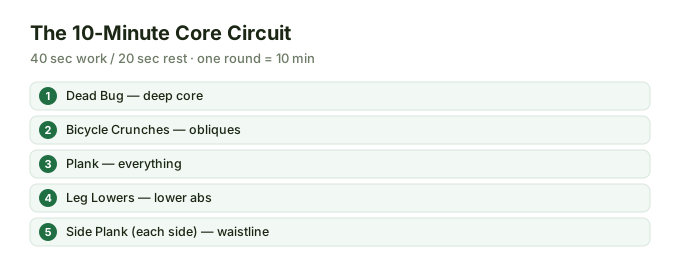
1. Dead Bug — 40 seconds
Lie on your back, arms straight up, knees bent at 90° over your hips. Slowly lower your right arm overhead and left leg toward the floor, keeping your lower back pressed down. Return, switch sides.
The cue that matters: if your lower back arches off the floor, you’ve gone too far. Shorten the range. This is an anti-extension exercise — the deep core work is in resisting the arch, not in the reaching.
Looks silly. Works the transverse abdominis better than almost anything.
2. Bicycle Crunches — 40 seconds
Hands lightly behind your head (don’t pull on your neck), elbow toward the opposite knee as you extend the other leg. Slow and controlled — aim for about 2 seconds per side, not a frantic pedal.
Hits the obliques, which regular crunches largely ignore.
3. Plank — 40 seconds
Forearms down, elbows under shoulders, body in one straight line from head to heels. Squeeze your glutes and brace your abs as if you’re about to be poked in the stomach.
Common fault: hips creeping up into a pike, which turns it into a rest. If your hips sag or rise, drop to your knees and hold a good position instead of a long one. Thirty good seconds beats sixty sloppy ones.
4. Leg Lowers — 40 seconds
On your back, legs straight up toward the ceiling, hands under your lower back or by your sides. Lower both legs slowly toward the floor — 4 seconds down, 2 seconds back up — stopping before your lower back lifts.
Hardest one for most people. If your back arches, bend your knees slightly or lower only halfway.
5. Side Plank — 40 seconds each side
Stack up on one forearm, elbow under shoulder, hips lifted so your body is a straight line. Hold. Then switch.
Trains anti-rotation and lateral stability — the thing that keeps your torso steady when you carry something heavy in one hand.

5 Mistakes That Waste Your 10 Minutes
- Going fast. Every move here is better slow. Momentum does the work when you rush, and momentum doesn’t build anything.
- Holding your breath. Almost universal, and it spikes pressure in ways that work against you. Breathe out on the hard part of each rep, in on the easy part.
- Letting the lower back arch. In dead bugs and leg lowers, an arching back means your deep core has stopped working and your hip flexors have taken over. Reduce the range instead of pushing through.
- Pulling on your neck. In bicycle crunches, fingertips rest behind the head — they don’t yank. A sore neck the next day means your hands did the work.
- Doing only this. Ten minutes of core is excellent as a supplement, not a whole program. Pair it with walking, strength work, or anything that gets you moving — the core work amplifies everything else rather than replacing it. This is the mistake that quietly limits results for people who otherwise do everything right.
Making It Progress
The circuit gets easier fast. Three ways to keep it working:
- Extend the work interval. Move from 40/20 to 45/15, then 50/10.
- Slow the tempo. Take 4 seconds per rep instead of 2. Same moves, dramatically harder.
- Add a round. Twenty minutes, two circuits, once you can hold good form through the whole first one.
Frequency: 3–4 times a week is the sweet spot. Your core recovers faster than large muscle groups, but daily hard core work with no recovery still hits diminishing returns.
When to see a professional: stop and get checked out if you feel sharp lower back pain (as opposed to muscle fatigue), if you have a visible bulge or “doming” down the center of your abdomen during these moves — a possible sign of diastasis recti, common postpartum — or if you’re pregnant or recently postpartum and haven’t cleared core work with a provider.
Mini FAQ
How often should you do a 10-minute ab workout?
Three to four times a week, with at least one day between sessions. Core muscles recover relatively quickly, but they still need recovery time to adapt. Daily is fine only if you’re alternating between hard and very light sessions.
Will a 10-minute ab workout give me a flat stomach?
It’ll build the muscle underneath and improve your posture, both of which change how your midsection looks. But visible definition comes down to overall body fat, which is driven by total activity and nutrition — no amount of core work spot-reduces fat from the abdomen.
What’s better: planks or crunches?
Both, for different jobs. Planks train anti-extension and deep stability — arguably more useful for everyday function and back health. Crunches train spinal flexion, which is a real movement pattern too. This circuit deliberately includes both, plus rotation and lateral work, because the core does four jobs and only training one of them leaves gaps.
TL;DR
- Five moves, 40 on / 20 off, ten minutes. Dead bug, bicycle crunch, plank, leg lowers, side plank.
- Slow beats fast. Control every rep; momentum builds nothing.
- Keep your lower back down in dead bugs and leg lowers — shorten the range rather than arching.
- Breathe out on the effort. Holding your breath works against you.
- 3–4 times a week. Progress by extending the interval or slowing the tempo.
- Core work builds strength, not fat loss. Visible abs are a nutrition outcome; this is the strength half.
Roll out of bed, hit the floor, and you’re done before your tea steeps. Start tonight.
Keep Reading
This article is for general informational purposes only and is not medical advice. It is not a substitute for professional diagnosis or treatment. Always consult a qualified healthcare provider about your individual situation, especially before making significant changes to your diet or exercise routine.